Fixed collateral per position. Max loss = what you allocate. No netting. Beginner-friendly.
One wallet pool for all futures. Shared buffer reduces per-position liquidation risk. No netting across products.
Nets risk across spot + futures + options. Stress-scenario based. 30–80% margin reduction for hedges. Gated by equity/KYC.
What Is Portfolio Margin?
L0: Portfolio margin is a margin methodology that sets requirements based on the net risk of all positions in one account, not per-position.
Traditional margin modes — isolated and cross — charge margin based on each position's gross notional exposure. Portfolio margin takes a fundamentally different approach: it looks at your entire book as one portfolio, models hundreds of stress scenarios across price moves, volatility changes, and time decay, then sets your margin requirement equal to the worst projected loss across all those scenarios.
The result: if you hold a long BTC spot position and a short BTC perpetual futures position of equal size, your net directional risk is near zero. Portfolio margin recognizes this and charges near-zero margin for the pair. Under isolated or cross margin, you'd pay full margin on both legs separately.
Portfolio margin covers spot, margin lending, perpetual futures, dated futures, and options in a single engine. It is designed for professional traders, market makers, arbitrageurs, and institutions.
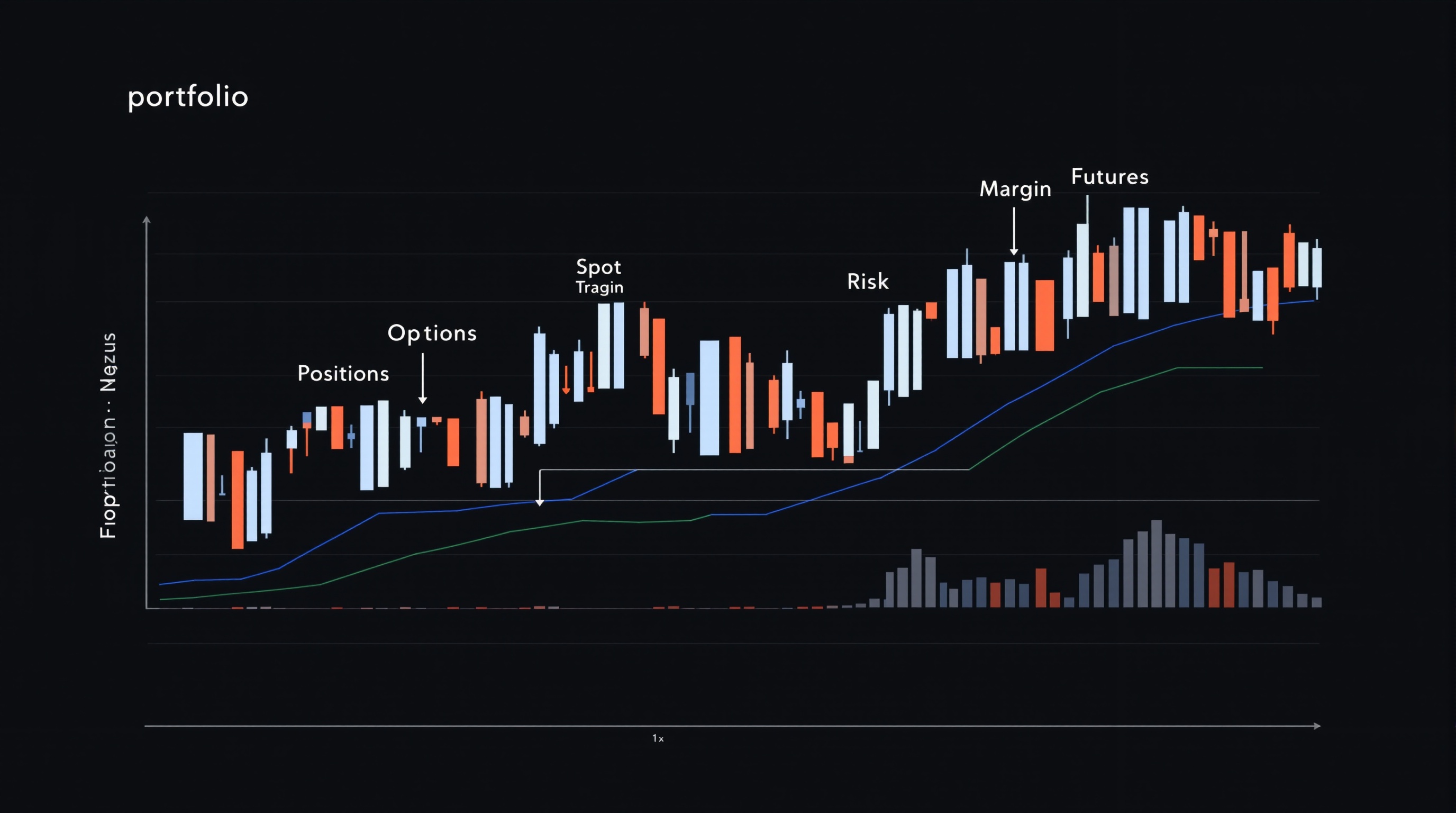
Cross-Product Netting
Long spot and short perp on the same asset net to near-zero margin. Options delta offsets futures exposure. Calendar spread legs net against each other.
Scenario-Based Risk Calc
Exchange models 1,000+ price/vol/time scenarios. Your margin = the worst-case loss across all scenarios — not a fixed % of notional.
Professional Trader Focus
Gated by minimum equity, KYC tier, and options trading permissions. Not available to all users. Built for institutional and advanced retail.
How Portfolio Margin Works
L0: The exchange models stress scenarios across price, volatility, and time; your margin equals the worst-case projected loss.
When you have portfolio margin activated, the exchange's risk engine continuously recalculates your margin requirement in real time using scenario-based modeling. For each asset in your account, it simulates a range of price shocks (e.g., ±5%, ±10%, ±20% for BTC), volatility changes (e.g., vol up 30%, vol down 30%), and time decay scenarios. These form a matrix — OKX models over 1,000 scenarios; CME's traditional SPAN uses 16.
For each scenario, the engine calculates what your entire portfolio would be worth. The margin requirement = the worst projected loss across all scenarios. If your portfolio is well-hedged (losses in one product offset gains in another), the worst-case scenario is small — and so is your margin. If you hold naked unhedged positions, the worst-case scenario is large — and so is your margin.
Portfolio Margin Logic — Simplified
Portfolio Margin vs Cross Margin vs Isolated
L0: Isolated caps risk per trade, cross shares one pool, portfolio margin nets risk across all products.
Source: Bybit UTA, OKX Unified Account, Binance PM Pro documentation (April 2026). Portfolio margin typically delivers 30–80% lower capital requirements for hedged books vs cross margin.
SPAN vs VaR Risk Models
L0: Portfolio margin uses SPAN (16-scenario grid) or VaR (statistical, captures correlations). Most crypto exchanges use VaR-style scenario nets.
SPAN
Standard Portfolio Analysis of Risk
- Developed by CME Group in 1988 — industry standard for TradFi derivatives
- Uses a 16-scenario grid: price up/down, vol up/down, and intermediate combinations
- Captures delta and gamma but limited vol surface modeling
- Fast, deterministic, and well-understood by regulators
- Still used by CME, ICE, Eurex, and some crypto derivatives desks
VaR-Style Scenario Nets
As used by OKX, Bybit, Binance
- Models 1,000+ price/vol/time scenarios per underlying — far more granular than SPAN
- Captures cross-asset correlations: BTC move affects ETH margin requirement
- Options priced across full vol surface for each scenario (not just flat IV)
- Dynamically recalculated in real time as market conditions shift
- Industry migration: most major crypto exchanges have adopted this approach post-2021
Which Model Do Major Crypto Exchanges Use?
Source: OKX Help Center, Bybit Derivatives documentation, Binance PM Pro whitepaper (April 2026).
Portfolio Margin on Bybit (UTA)
L0: Bybit offers Portfolio Margin inside its Unified Trading Account (UTA) for qualified users.
Bybit's Unified Trading Account (UTA) consolidates spot, margin, USDT perps, USDC perps, inverse futures, and options under one account. UTA Pro — the portfolio margin tier — activates full cross-product netting: a long BTC spot position and a short BTC USDC perpetual offset each other in the margin engine, dramatically reducing required collateral.
UTA nets USDC perpetuals, dated futures, and options with near-zero margin for delta-hedged combinations. USDT perpetuals have partial netting. Bybit's implementation is particularly strong for USDC-denominated derivatives traders.
Go to Account Settings → Unified Trading Account. Ensure UTA is activated (most new Bybit accounts default to UTA).
Enable Options Trading permissions — required before portfolio margin activates. Options trading requires identity verification (KYC Level 2).
Check net asset value eligibility. Bybit reviews equity thresholds for UTA Pro — contact Bybit support or check your account tier in the Derivatives settings.
Once activated, the margin displayed in your account will reflect the netted portfolio margin requirement — typically much lower for hedged books.
Try Bybit UTA — Best USDC Perp Portfolio Margin
Unified Trading Account nets USDC perps, futures, and options. Spot-vs-perp basis trades with near-zero margin requirement. New accounts eligible for up to $30,000 in welcome rewards.
Portfolio Margin on OKX (Unified Account)
L0: OKX Unified Trading Account supports Portfolio Margin across spot, margin, futures, and options with three sub-modes.
OKX's Unified Account has three modes: Spot Mode (no leverage), Single-Currency Margin (margin per currency, partial netting), and Multi-Currency Margin (full portfolio margin across all currencies and products). Multi-Currency Margin is OKX's equivalent of portfolio margin and is the most capital-efficient mode.
OKX runs Greeks-based netting: a long BTC call and a short BTC perpetual are delta-matched, reducing the netted margin to near zero for the delta component. The remaining margin covers residual gamma, vega, and theta risks. On typical hedges (long BTC call, short BTC perp), OKX reduces margin 40–70% compared to cross margin.
No leverage. Spot only. Minimal margin requirements. Not portfolio margin — entry-level mode for non-leveraged users.
Each currency (BTC, ETH, USDT) has its own margin pool. Partial netting within a currency. Cross-currency netting not enabled.
Full portfolio margin. All currencies and products — spot, margin, futures, options — netted in one risk engine. Greeks-based netting for options. Min ~$10K+ equity required.
Portfolio Margin on Binance
L0: Binance Portfolio Margin Pro nets USDⓈ-M Futures, COIN-M Futures, and options in one risk engine. Designed for institutions.
Binance PM Pro is the institutional tier of Binance's margin offering. It nets USDⓈ-M Futures, COIN-M Futures, and Binance Options across a unified margin account. The typical equity requirement is $2M+ net asset value, making it primarily accessible to professional trading desks, funds, and high-net-worth traders.
Binance PM Pro applies tiered leverage — up to 20× leverage at smaller debt brackets, scaling down as total liability grows. Auto-liquidation priority runs from smallest positions to largest, attempting to restore margin ratio before closing core positions. The risk engine uses proprietary stress scenarios modeled on historical crypto volatility regimes.
Typical eligibility: $2M+ net equity
Binance PM Pro is institutional-focused. Most retail applications are denied below $2M. Apply through the Derivatives VIP onboarding portal.
Products netted: USDⓈ-M + COIN-M + Options
USDⓈ-M futures (stablecoin settled), COIN-M inverse futures (coin settled), and Binance vanilla options are all netted.
Leverage: up to 20× at lower debt brackets
Leverage scales down with total liability. Small positions: up to 20×. Large institutional books: typically 3–5× effective leverage after tiers.
Auto-liquidation priority
Binance liquidates smallest positions first, then scales up, attempting to restore margin ratio before triggering full account liquidation.
Who Qualifies for Portfolio Margin?
L0: Usually gated by minimum equity, KYC tier, and trading volume history.
- UTA activated (default for most new accounts)
- Options trading permissions enabled
- KYC Level 2 completed
- Equity threshold reviewed by Bybit team
- Typically accessible to retail traders with options history
- Standard KYC verification
- ~$10,000+ account equity
- Options trading enabled
- Activate through Unified Account settings
- No formal application — self-service upgrade
- Typically $2M+ net asset value
- VIP-level trading volume history
- Institutional KYC / compliance docs
- Application via Derivatives VIP portal
- Ongoing review and maintenance requirements
When to Use Portfolio Margin
L0: Use it for hedged books — spot-vs-perp, futures-vs-options, or delta-neutral strategies.
Cash-and-Carry / Basis Trade
Long spot BTC + short BTC perp. Capture the funding rate while holding near-zero directional risk. Funding arb frees 60–80% margin vs cross mode — your capital goes further on more basis positions.
Volatility Arbitrage
Long options (buy vol) + short futures (hedge delta). Portfolio margin nets the delta component, charging margin only on the residual vega. Allows larger vol arb book with the same capital.
Delta-Neutral Yield
Run delta-neutral books — buy spot, short perp, sell options premium. Portfolio margin treats the entire strategy as one low-risk unit, reducing margin 40–70% on the combined structure.
Calendar Spreads
Long near-dated futures + short far-dated futures. Two legs of the same underlying with opposite tenors. Portfolio margin recognizes the low net risk and charges minimal margin for the spread.
Pros and Cons of Portfolio Margin
- 30–80% lower margin for hedged books vs cross margin — massive capital efficiency gain
- Nets options + futures + spot — single account manages all derivatives strategies
- Frees collateral for more positions — basis traders can run larger books with the same capital
- Greeks-based netting on options (OKX) — delta-hedged structures priced at near-zero margin
- Real-time stress testing — more accurate risk picture than simple % of notional
- Complex — requires understanding of stress scenarios, Greeks, and multi-product netting logic
- Gated by equity and KYC — not accessible to all retail traders, especially beginners
- Cross-product liquidation cascade — a stress scenario can trigger simultaneous liquidation across all positions
- Not for beginners — misuse of freed capital in unhedged positions amplifies risk, not reduces it
- Engine opacity — exact scenario parameters are proprietary; full margin calculation is a black box
Portfolio margin is genuinely transformative for my basis trading. I run a BTC cash-and-carry on OKX Multi-Currency Margin and the capital efficiency vs cross margin is dramatic — same P&L, fraction of the margin requirement. I can run 3–4× more size on the same collateral base.
My recommendation: OKX for options + futures hedges (best Greeks netting); Bybit UTA for USDC perp basis trades; Binance PM Pro only if you're institutional size. If you're still learning derivatives, start with cross margin — understand the position mechanics first before you unlock portfolio margin mode.
Try Portfolio Margin on Bybit UTA
Unified Trading Account nets spot, USDC perps, futures, and options. Activate options trading to unlock portfolio margin mode. Up to $30K in welcome rewards for new accounts.
Open Bybit Account — Up to $30K Bonus