Mark price hits liquidation level (margin = MMR)
Exchange liquidation engine — automatic, instant
Your initial margin (+ liquidation fee)
What Is Liquidation in Crypto?
L0: Liquidation is the forced closure of a leveraged futures position when margin drops below the maintenance requirement.
When you open a leveraged futures position, you only post a fraction of the total position value as initial margin. As the market moves against you, your margin gets eaten into. Once it drops to the exchange's maintenance margin requirement (MMR), the exchange automatically force-closes the position — this is liquidation.
Liquidation is a safety mechanism: it prevents your account from going negative. Without it, you could owe money to the exchange. It applies to perpetual futures, dated futures, and margin trading — not spot.
Automatic & Instant
The liquidation engine monitors positions in real-time. There is no warning call — it triggers the moment mark price hits your liquidation level.
Applies to Futures Only
Spot trading has no liquidation. Leverage in perpetuals, dated futures, and margin trading all carry liquidation risk.
Prevents Negative Balance
Liquidation closes your position before losses exceed your margin — so you can't owe the exchange more than you deposited.
How Does Liquidation Work?
L0: Liquidation triggers when mark price reaches your liquidation price — the level where your margin equals the maintenance margin.
Every leveraged position has a liquidation price — a specific mark price level at which your remaining margin exactly equals the maintenance margin requirement. Once mark price crosses that level, the exchange's liquidation engine takes over.
Most exchanges attempt a partial liquidation first — they reduce position size enough to restore equity above MMR without closing the entire position. If partial reduction fails (market moves too fast), the full position is closed at the bankruptcy price. The gap between liquidation price and bankruptcy price is covered by the insurance fund.
- 1Mark price declines continuously against your long position
- 2Margin ratio rises — Bybit's Risk Indicator moves toward 100%
- 3At 100% (mark price = liquidation price), engine activates
- 4Partial reduction attempted first — size cut to restore MMR
- 5If partial fails, full position closes at or near bankruptcy price
- 6Liquidation fee (Bybit: 0.5%) deducted from remaining margin
- 7Remaining margin (if any) returned to your wallet
Key Price Levels
Where you opened the position
Mark price where MMR is breached — engine triggers
Where initial margin = $0 — extreme loss level
Liquidation Price Formula
L0: Liquidation price for a long is Entry × (1 − 1/Leverage + MMR); for a short, Entry × (1 + 1/Leverage − MMR).
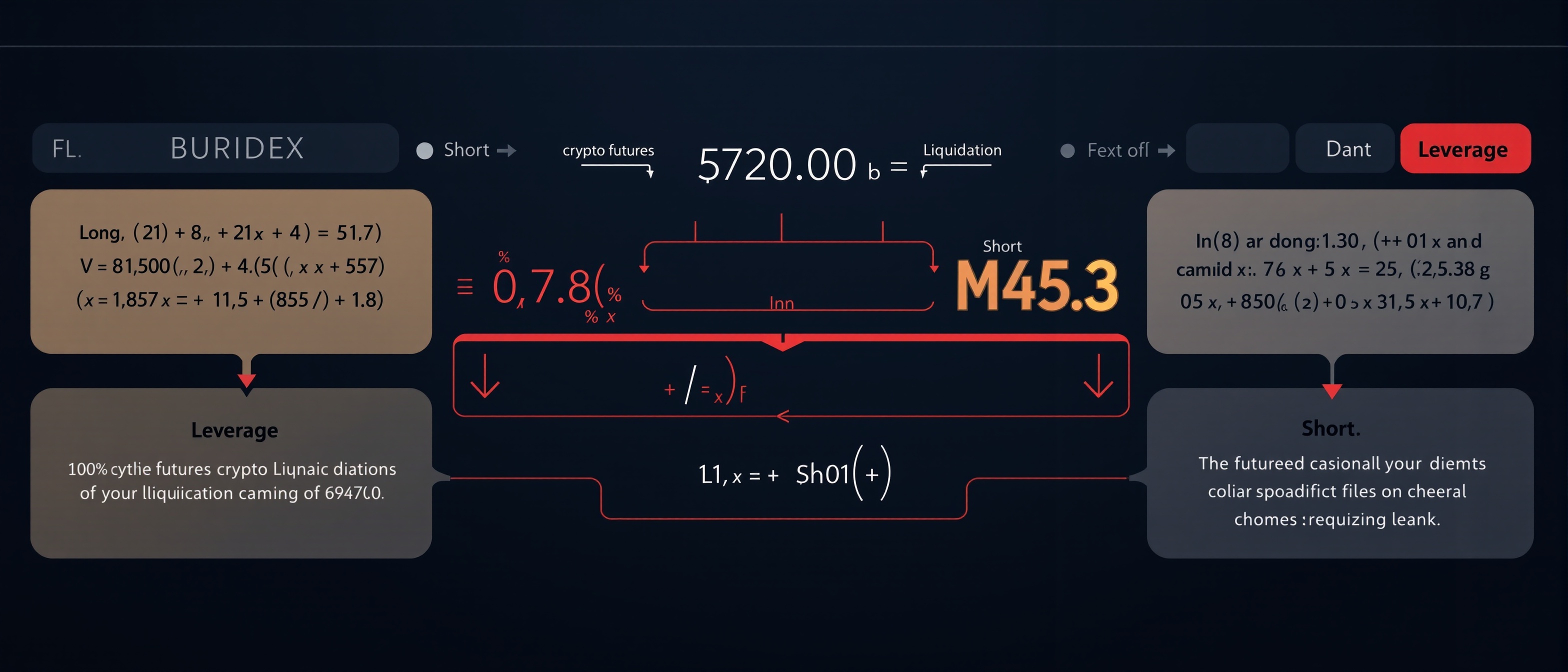
Liq Price = Entry × (1 − 1/L + MMR)
Example: Long ETH at $3,000 · 5× leverage · MMR 1%
= $3,000 × (1 − 1/5 + 0.01)
= $3,000 × (1 − 0.2 + 0.01)
= $3,000 × 0.81
≈ $2,430 liquidation price
Liq Price = Entry × (1 + 1/L − MMR)
Example: Short BTC at $70,000 · 10× leverage · MMR 0.5%
= $70,000 × (1 + 1/10 − 0.005)
= $70,000 × (1 + 0.1 − 0.005)
= $70,000 × 1.095
≈ $76,650 liquidation price
| Leverage | Distance to Liq (%) | Entry $70k → Liq at | Risk Level |
|---|---|---|---|
| 2× | ~49.5% | $35,350 | Low |
| 5× | ~19.5% | $56,650 | Moderate |
| 10× | ~9.5% | $63,350 | High |
| 25× | ~3.5% | $67,550 | Very High |
| 50× | ~1.5% | $68,950 | Extreme |
| 100× | ~0.5% | $69,650 | Extreme |
100× leverage = just 0.5% adverse move to liquidation. Data: Bybit BTC/USDT MMR tier 1 (April 2026).
Mark Price vs Last Price
L0: Liquidation uses mark price — a fair-value composite from multiple spot exchanges — not the last traded price.
Mark price is a fair-value price calculated as a weighted index of BTC/ETH prices across major spot exchanges: Binance, Coinbase, Kraken, OKX, and Bitstamp. It's updated continuously and is smoothed against short-term manipulation.
Without mark price, a single large sell order on Bybit could temporarily drop the last traded price by 3–5%, triggering thousands of liquidations — even though every other exchange shows the "true" price. Mark price prevents this. This is one of the most trader-friendly features of modern futures exchanges.
Last price is the most recent trade price on that exchange. It's susceptible to:
- Wick manipulation — single large order creates fake spike
- Low liquidity periods — thin order books amplify moves
- Exchange-specific data — not reflective of global price
Mark price = median of spot index prices + funding rate basis adjustment:
- Bybit/Binance index: Binance, Coinbase, Kraken, OKX, Bitstamp
- Weighted by volume and exchange reliability
- Outlier prices beyond ±0.5% std dev are filtered out
- Updated every second — smooth, manipulation-resistant
Maintenance Margin and Risk Tiers
L0: Maintenance margin is the minimum equity you must hold to keep a position open, rising with position size.
Maintenance Margin Rate (MMR) is not fixed — it increases in tiers as your position gets larger. This is by design: large positions have more market impact and require higher safety buffers. The tiered system means that as you scale up notional size, effective maximum leverage decreases automatically.
On Bybit, tier 1 for BTC/USDT starts at 0.5% MMR up to $50,000 notional. At $5M+, MMR jumps to 5%+. This forces whale traders to operate at lower leverage, protecting the insurance fund from outsized drawdowns.
Source: Bybit Help Center — BTC/USDT Perpetual Risk Limits (April 2026). Binance uses a similar tiered MMR scheme.
Bankruptcy Price and Insurance Fund
L0: Bankruptcy price is where your initial margin is fully depleted; the insurance fund covers the gap if liquidation fills below it.
The bankruptcy price is below the liquidation price for longs (above for shorts). It's the level where your position's loss would exactly equal your entire initial margin — account equity hits zero. Exchanges try to close you out at the liquidation price, not the bankruptcy price. But in fast markets, the fill might slip below the bankruptcy price.
That's where the insurance fund steps in. It absorbs the deficit between the bankruptcy price and the actual fill price. The insurance fund is funded by liquidation fees and by positions that close above the bankruptcy price during normal liquidations. In 2026:
Bybit's insurance fund grew significantly in 2024–2026 from high futures trading volume and liquidation fees. Fund size is publicly viewable in Bybit's transparency report.
Source: Bybit Transparency Report, April 2026
Binance maintains the largest insurance fund in the industry, tracked on CoinGlass. Exceeds $1B across USDⓈ-M and COIN-M futures combined as of Q1 2026.
Source: CoinGlass Insurance Fund Tracker, April 2026
Liquidation Price vs Bankruptcy Price — Visual Comparison
Example: 10× long BTC at $70k, MMR 0.5%, isolated $1,000 margin. Bybit.
What Is Auto-Deleveraging (ADL)?
L0: ADL is a last-resort mechanism that force-closes profitable counterparty positions when the insurance fund can't cover losses.
ADL kicks in when the insurance fund is exhausted and cannot cover a bankrupt position's deficit. The exchange must find the funds somewhere — so it auto-closes positions of profitable traders on the opposite side. This is deeply unpopular with traders because it closes your profitable position without your consent.
You are ranked in the ADL queue based on your PnL% × effective leverage. The most profitable and most leveraged counterparty positions get hit first. Bybit and Binance display your ADL rank on each position (5 bars = highest ADL risk / most likely to be hit).
When ADL Triggers
Only when: (1) a position goes bankrupt, AND (2) the insurance fund cannot cover the full deficit. In normal markets, ADL is extremely rare.
ADL Ranking System
Your ADL rank = PnL% × leverage. Position in the top 20% of profitable shorts (if insolvency is a long) get hit first.
Last Major ADL Event
October 10–11, 2025: ADL triggered across multiple venues during extreme BTC volatility. Reported by CCN and CoinGlass.
Common Causes of Liquidation
L0: Main causes are excessive leverage, no stop loss, and trading volatility without buffer.
01. Excessive Leverage (20×+)
At 20× leverage, a 4.5% adverse move is enough to liquidate you (accounting for MMR). Crypto routinely moves 5–15% in hours. 90%+ of liquidations happen at 20× or higher. This is the #1 cause by a massive margin.
02. No Stop Loss
Trading without a stop loss means relying entirely on your margin buffer. In trending markets, that buffer can evaporate faster than you can manually close. A stop loss above your liquidation price gives you a controlled exit before the exchange force-closes you.
03. Thin Margin Buffer
Opening positions at or near your maximum leverage with minimal free margin means any funding rate payment, fee, or slight adverse move tips you over. Leave 30–50% of your allocated margin as buffer above the liquidation price.
04. News & Black Swan Events
FOMC prints, exchange hacks, ETF rejection/approval, stablecoin depeg, regulatory news — these events cause 10–30% candles in minutes. Positions that survive normal volatility get wiped instantly. Reduce exposure before major scheduled events.
05. Misusing Cross Margin
Running high-leverage speculative positions in cross margin mode means a single bad trade can drain your entire futures wallet, liquidating all your other positions too. Cross margin + high leverage is the most dangerous combination in crypto trading.
How to Avoid Liquidation
L0: Lower leverage, add margin buffer, set stops above liquidation, monitor mark price.
Use ≤10× Leverage
At 10×, you need a 9%+ adverse move to get liquidated. Crypto rarely sustains 9% moves in minutes unless it's a black swan. Most of my profitable trades ran 3–5× leverage.
Keep 2× Margin Buffer
If your position requires $500 margin at your desired leverage, deposit $1,000. The extra buffer absorbs funding fees, small adverse moves, and gives you time to react before liquidation.
Stop 20% Above Liq Price
If liquidation is at $63,000, put your stop at $65,600 — 20% of the distance between entry and liquidation. This gives you a clean exit well before the engine activates.
Use Isolated for Speculation
High-leverage or event-driven trades go in isolated margin — never cross. Cap your max loss at what you allocate. Your remaining wallet stays safe no matter what.
Reduce Before News
FOMC, CPI, SEC ETF decisions, major exchange hacks — reduce position size by 50–75% before known high-impact events. Re-enter after the dust settles.
Practice risk management on Bybit
Built-in liquidation calculator, mark price display, isolated margin per symbol, risk indicator bar. Everything you need to trade futures safely. New accounts up to $30,000 in welcome rewards.
My first liquidation in 2020 was a $2,400 lesson on 50× leverage during a wick. My second was in 2022 — the Terra/Luna collapse. My third was in 2023 from a funding rate bleed I didn't account for. Each one was entirely avoidable.
The formula is simple: mark price + liquidation price + MMR tier. Know these three numbers before entering any leveraged position. Set your stop 20% above liquidation. Use isolated margin for anything over 5×. Keep a 2× buffer.
I haven't been liquidated since 2023 — not because I stopped trading high leverage, but because I started treating risk management as the primary skill, not trade direction.
Trade Futures on Bybit
Mark price liquidation, $500M+ insurance fund, built-in liq calculator, isolated margin per symbol. The safest futures platform I've tested since 2020.
Open Bybit Account — Up to $30K Bonus