 RonOnCrypto
Maker vs Taker Fees in Crypto Futures: How They Work and How to Cut Them Without Adding Risk
On this page · 9
- What do maker and taker mean?
- Which orders pay the maker fee and which pay the taker fee?
- Are trading fees charged on position value or on margin?
- How much of your 1R risk do round-trip fees take?
- How does a maker entry change position size at 1% risk?
- What is a post-only order?
- What are maker rebates and volume-based fee tiers?
- How are trading fees different from funding?
- Checklist: cutting fees without adding risk
Need leverage, liquidation price and take-profit targets? Open the full calculator.
Maker and taker fees are two trading fee rates set by the role your order plays when it fills: a maker order rests on the order book before it fills (adding liquidity), while a taker order fills immediately against resting orders (removing liquidity). The taker fee is usually higher, and both are charged on position value, not on margin.
The guide to futures order types already has a table of which orders usually end up maker or taker, and the total fee for three entry and exit combinations. This guide goes deeper into fees themselves: what maker and taker mean on the order book, what the fee is charged on, how much of your 1R risk it eats, how far price must move to cover it, how sizing changes with a maker entry, post-only orders, maker rebates, fee tiers, how fees differ from funding, and a checklist. The short version: the fee is small per trade but it is a fixed slice of every 1R, so it belongs inside your position sizing, not as an afterthought.
| Term | What it means | In the standard trade |
|---|---|---|
| Maker | An order that rests on the book before filling, adding liquidity | A resting buy limit, illustrative fee 0.02% |
| Taker | An order that fills immediately against resting orders | Market and stop market orders, illustrative fee 0.05% |
| Fee base | Position value (quantity × fill price) | 909.50 USDT, not the 90.95 USDT margin |
| Round-trip fee | Entry fee plus exit fee | About 0.90 USDT at the stop, taker both ways (0.91 USDT if both sides are priced at entry) |
| Break-even price | The price where profit just covers both fees | 80,080.04 with taker on both sides |
| Post-only | A limit order that may only enter the book as a maker | Rejected if it would fill immediately |
The examples use the standard trade from the other guides on this site: a 1,000 USDT account, 1% risk (10 USDT), BTC long at 80,000, stop at 79,200, 0.05% fee per side, a 909.50 USDT position (0.01136875 BTC), 10x leverage, 90.95 USDT margin, 0.5% maintenance margin and an estimated liquidation price of 72,400. The 0.02% maker and 0.05% taker rates are illustrations; every platform has its own fee schedule. Order books and price paths below are simulated, not market data.
What do maker and taker mean?
The maker is the side whose order rests on the order book; the taker is the side whose order fills immediately against that resting order. Binance’s futures fee FAQ defines a taker trade as one that happens when you place an order that executes immediately, and a maker order as one that sits on the book until it is matched (accessed 23 November 2026).
The order book is the list of resting buy and sell orders at each price. A maker order makes the book deeper, which is why it is said to add liquidity; a taker order consumes resting orders, so it removes liquidity. Platforms charge takers more to reward people who post resting orders, because a deeper book lets everyone trade with less slippage.
Take a simulated order book with the best bid at 79,990 and the best ask at 80,000:
- Buy limit at 79,990: the order joins the queue of bids and only fills when someone sells down to 79,990. When it fills, you are the maker.
- Market buy: the order fills at once against the resting sell at 80,000. You are the taker, and whoever posted that sell is the maker.
Maker or taker describes an order’s role at the moment it fills, not a type of account or trader. The same person can be the maker on entry and the taker on exit.
Which orders pay the maker fee and which pay the taker fee?
An order that fills the moment it reaches the book pays the taker fee; an order that rests first and fills later pays the maker fee; the order type only decides which role is likely. Market and stop market orders are always takers, and a limit order is a maker if it rests, but a taker if its price crosses the opposite side and it fills immediately. The full breakdown of each order type and how it fills is in the guide to futures order types.
Three cases trip people up:
- A limit order does not guarantee the maker fee. Deribit’s public fee documentation states that a limit order does not guarantee maker status, and that you need to enable the post option to be sure (accessed 23 November 2026).
- A stop limit depends on what happens at the trigger. If the limit order it creates fills immediately, it is a taker; if it rests and fills later, it is a maker.
- A stop loss is almost always a taker. A stop market order prioritises getting out, so it pays the taker fee; this is the hardest side to make cheaper, and it should be counted in full when you measure the loss.
On the take profit side, a TP limit order already resting on the book usually pays the maker fee. On the standard trade, the profit at 81,600 is 17.27 USDT with taker fees on both sides and 17.82 USDT with maker fees on both sides. How to combine a TP limit with a stop market on the same position is covered in the guide to take profit and stop loss.
Are trading fees charged on position value or on margin?
Fees are charged on position value, meaning quantity times fill price, including the part financed by leverage; margin is not part of the formula. Binance’s futures fee FAQ gives the formula as trading fee = position value × fee rate, where position value is contract size times execution price (accessed 23 November 2026).
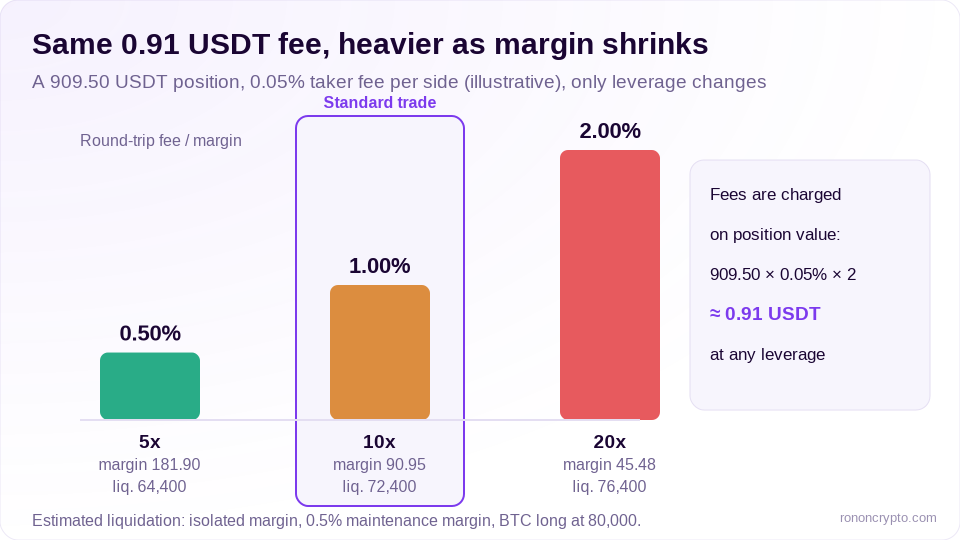
So leverage does not change the fee in USDT, but it does change how large the fee looks against your margin. Holding the position at 909.50 USDT, the round-trip taker fee is about 0.91 USDT (taken on position size on both sides):
| Leverage | Margin | Round-trip fee | Fee as share of margin | Estimated liquidation |
|---|---|---|---|---|
| 5x | 181.90 USDT | 0.91 USDT | 0.50% | 64,400 |
| 10x | 90.95 USDT | 0.91 USDT | 1.00% | 72,400 |
| 20x | 45.48 USDT | 0.91 USDT | 2.00% | 76,400 |
Because ROE is PnL divided by margin, at 20x the fees alone cost 2% of ROE before price moves at all. That is the “tiny fee” illusion of reading ROE: the fee in USDT stays the same, only the denominator shrinks. Higher leverage does not make a trade cheaper or more expensive; it moves the liquidation price closer, as explained in the guide to crypto leverage.
How much of your 1R risk do round-trip fees take?
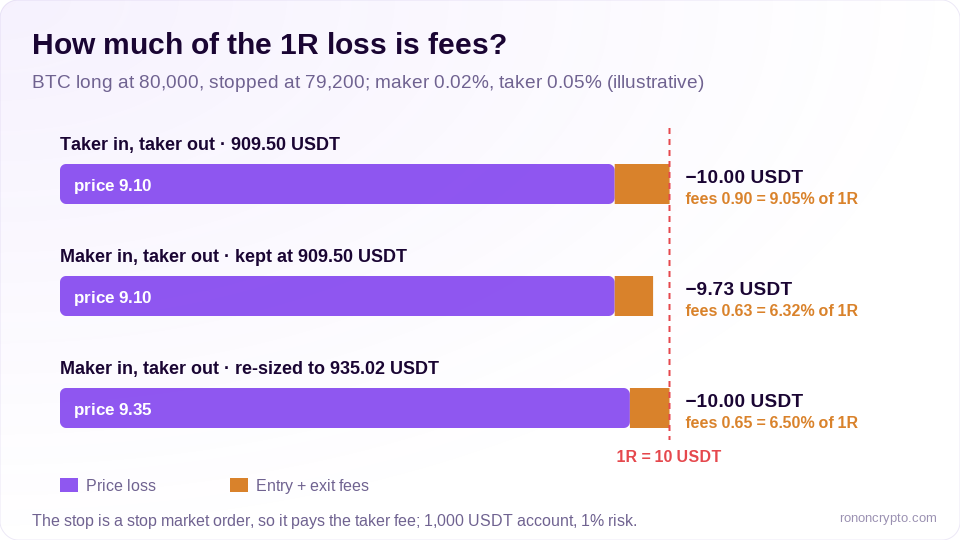
On the standard trade with taker fees of 0.05% on both entry and exit, round-trip fees at the stop are about 0.90 USDT, which is 9.05% of the 10 USDT risk; the other 9.10 USDT is the price loss. The tighter the stop, the bigger the fee’s share of 1R, because fees scale with position size and a tighter stop means a larger position.
| Entry and exit | Price loss | Round-trip fee | Total loss at 79,200 | Fee share of 1R |
|---|---|---|---|---|
| Taker in, taker out (909.50 USDT) | 9.10 USDT | 0.90 USDT | 10.00 USDT | 9.05% |
| Maker in, taker out (kept at 909.50 USDT) | 9.10 USDT | 0.63 USDT | 9.73 USDT | 6.32% |
| Maker in, taker out (re-sized to 935.02 USDT) | 9.35 USDT | 0.65 USDT | 10.00 USDT | 6.50% |
The exit fee in the table is charged at the 79,200 fill, so it is slightly lower than a fee charged at the entry price. At the take profit the exit fee is charged at 81,600 and is a little higher: with taker on both sides, the fee on a 1:2 winner is about 0.92 USDT.
Fees also set your break-even price. For a long, break-even = entry × (1 + entry fee) ÷ (1 − exit fee):
| Entry and exit | Break-even price | Move needed | Share of the 800 USDT stop distance |
|---|---|---|---|
| Taker in, taker out | 80,080.04 | +80.04 (+0.10%) | 10.01% |
| Maker in, taker out | 80,056.03 | +56.03 (+0.07%) | 7.00% |
| Taker in, maker out | 80,056.01 | +56.01 (+0.07%) | 7.00% |
| Maker in, maker out | 80,032.01 | +32.01 (+0.04%) | 4.00% |
Moving the stop to exactly 80,000 “to break even” still loses the fees if it gets hit. A true break-even stop sits at the break-even price, for example 80,080.04 with taker fees on both sides.
How does a maker entry change position size at 1% risk?
If you keep the 909.50 USDT position and enter with a 0.02% maker order, the loss at the stop falls to 9.73 USDT; if you re-size to exactly 10 USDT of risk, the position grows to 935.02 USDT (+2.81%) and the loss is still 10.00 USDT. Both approaches are valid; the choice is whether the fee you save becomes lower risk or a larger position.
The risk-based sizing formula with the fee split by side:
- Quantity (BTC) = Risk ÷ [(Entry − Stop) + Entry fee × Entry + Exit fee × Stop]
- Taker entry: 10 ÷ (800 + 40 + 39.6) ≈ 0.011369 BTC, or 909.50 USDT.
- Maker entry: 10 ÷ (800 + 16 + 39.6) ≈ 0.011688 BTC, or 935.02 USDT, with 93.50 USDT margin at 10x.
The estimated liquidation price at 10x is still 72,400, because it depends on leverage and maintenance margin, not on size. The 935.02 USDT position reaching 81,600 with a taker exit makes about 18.04 USDT, against 17.27 USDT for the 909.50 USDT position.
The condition for using the maker figure: the entry has to actually fill as a maker. If the limit order fills immediately as a taker after you sized it on the maker rate, the loss at the stop will be slightly above 10 USDT. The position size calculator uses one fee rate for both sides, so for a maker entry and taker exit, size the trade with the formula above.
Over a month the gap gets clearer. Taking fees on 909.50 USDT on both sides, at 20 trades a month:
| Entry and exit | Fee per trade | Fees for 20 trades/month | Share of a 1,000 USDT account |
|---|---|---|---|
| Taker in, taker out | 0.910 USDT | 18.19 USDT | 1.82% |
| Maker in, taker out | 0.637 USDT | 12.73 USDT | 1.27% |
| Maker in, maker out | 0.364 USDT | 7.28 USDT | 0.73% |
With taker fees both ways, 20 trades a month cost about 1.82R in fees alone, before any trade wins or loses. Switching the entry to maker saves about 5.46 USDT a month at the same trade count; at 60 trades a month, taker fees both ways come to 54.57 USDT.
What is a post-only order?
A post-only order is a limit order that may only enter the order book as a maker: if it would fill immediately as a taker, the platform rejects it or reprices it so it rests. Binance’s public futures API documentation lists this time-in-force as GTX, “Good Till Crossing (Post Only)”, alongside GTC, IOC and FOK (accessed 23 November 2026).
Using the simulated book with the best bid at 79,990 and the best ask at 80,000:
- Post-only buy at 79,990: the order rests, and when it fills it pays the maker fee.
- Post-only buy at 80,000 or higher: the order would fill immediately against the resting sell, so it is rejected (or repriced below 80,000, depending on the platform). No fill means no fee.
Post-only trades a lower fee for the risk of missing the trade. If price runs and the order never fills, you have no position; chasing it with a market order at a higher price gives back the fee you saved and widens the stop distance, so the size has to be recalculated. That makes post-only a fit for non-urgent entries and take profits, not for stop losses.
What are maker rebates and volume-based fee tiers?
A maker rebate is a negative maker fee: instead of paying, the maker order is paid a small amount by the platform; fee tiers are a schedule of rates that fall as your trading volume or account balance rises. Deribit’s public fee documentation shows negative maker fees at some higher VIP tiers, noting that “a negative number indicates a rebate instead of a fee”, with tiers based on 30-day volume or equity (accessed 23 November 2026). The current fee levels of individual exchanges are listed on the exchanges page.
At the size of a 1,000 USDT account, a rebate barely changes anything. As an illustration, a −0.005% maker fee on 909.50 USDT pays back about 0.05 USDT per entry, against 10 USDT of risk per trade. Higher tiers typically require monthly volume many times the account size.
The risk is chasing a tier: adding trades to hit a volume target raises the trade count, and every one of those trades still carries a full 1R of risk. Lower fees only help when the number of trades comes from your trading plan, not from a volume goal.
How are trading fees different from funding?
A trading fee is charged by the platform every time an order fills, while funding is a periodic payment between longs and shorts for as long as a perpetual position stays open. Trading fees scale with how often you enter and exit, funding scales with how long you hold, and funding can be something you receive, not only something you pay. How funding is calculated and read is covered in the guide to the funding rate.
Both are charged on position value, so they can be compared directly. As an illustration: a funding rate of 0.01% per 8-hour interval, paid by longs, costs about 0.091 USDT per interval on a 909.50 USDT position. Holding for 3 days (9 intervals) at that rate costs about 0.82 USDT, close to the 0.91 USDT round-trip taker fee.
For trades held a few hours, trading fees are the main cost; for trades held several days, funding can match or exceed them. Funding changes every interval and differs by contract, so the figure above only shows the mechanics. The site’s fee calculator does not include funding.
Checklist: cutting fees without adding risk
Cutting fees the right way means changing how orders fill where a guaranteed fill is not needed, keeping the stop and building fees into the size; it does not mean raising leverage, dropping the stop or trading more.
- Put fees inside 1R: size from the stop distance plus round-trip fees, so hitting the stop loses exactly the risk you chose.
- Use post-only limits for non-urgent entries: accept that you may miss; do not chase with a market order without re-sizing.
- Take profits with resting TP limits: most take profits can fill as a maker.
- Keep the stop as a stop market: accept the taker fee on that side, because failing to exit is the bigger risk.
- Size with the right fee per side: maker in and taker out gives 935.02 USDT; taker both ways gives 909.50 USDT.
- Place a “break-even” stop at the break-even price: 80,080.04 with taker both ways, not 80,000.
- Count trades per month: 20 taker round trips cost about 18.19 USDT, or 1.82% of the account; do not add trades to reach a fee tier.
- Keep funding separate from trading fees: trades held for days need a funding estimate too.
The trading fee calculator takes your position size, trades per month, the maker and taker rates you enter (0.02% and 0.05% by default, not pulled from any platform’s schedule) and whether the entry and exit are maker or taker; it returns the fee per trade, fees per month and the move needed to cover fees. Your actual rates are on your platform’s fee schedule and can change over time.
For information only, not investment advice. Leveraged derivatives trading carries the risk of losing your entire margin.
FAQ
Where are maker and taker fees deducted from?
On USDT-margined contracts the fee is usually taken in USDT from the futures account balance as soon as the order fills, so the realised PnL of a trade is already net of fees. On coin-margined contracts it is taken in that coin; Binance's futures fee FAQ describes both cases (accessed 23 November 2026).
Do you pay maker or taker fees when you get liquidated?
A liquidation order fills on the order book, so it carries a trading fee, and many platforms add a separate liquidation fee on top. Deribit's public fee documentation says liquidation fees are charged in addition to regular trading fees and are not reduced by fee discounts (accessed 23 November 2026). That is one more reason to keep the standard 79,200 stop well above the 72,400 liquidation price.
How are fees charged on a partially filled order?
Each fill is charged according to its own role. A buy limit order placed above the best ask, for example, pays the taker fee on the part that fills immediately, and the maker fee on the rest if it then rests on the book and fills later. One order can therefore show two fee rates in your trade history.
Does cancelling an order cost a fee?
Usually not, because maker and taker fees are only charged when something fills. A resting limit order that you cancel, or a post-only order that gets rejected, creates no trading fee; the cost is that you may miss the move.
Derivatives trading can lose you your entire margin. See the disclaimer.