 RonOnCrypto
Crypto Leverage Explained: How It Works and Why It Does Not Change Your Risk
On this page · 7
- How does leverage work in crypto futures?
- Does leverage increase your risk?
- When does leverage actually increase risk?
- What is effective leverage, and how is it different from the leverage setting?
- What leverage should you use in crypto?
- Higher leverage makes ROE look better. Does it mean more profit?
- Use the position size calculator before you choose leverage
Need leverage, liquidation price and take-profit targets? Open the full calculator.
Crypto leverage is the ratio between the value of your position and the margin you post to hold it: 10x leverage means 1 USDT of margin controls 10 USDT of contract value. On BTC and ETH perpetual futures, leverage decides how much margin you lock and how far the liquidation price sits from your entry. It does not decide how much you lose when you are wrong, as long as your position size comes from your stop loss.
This guide covers, in order: how leverage works in futures, whether leverage increases risk (a 1x to 100x table for the same 909.50 USDT trade), when leverage really does increase risk, how effective leverage differs from the leverage setting, what leverage to use, and why a higher ROE does not mean more profit. The short version: size the trade first, then pick the lowest leverage that keeps margin manageable and liquidation well beyond your stop.
| Key fact | Value in this guide’s example |
|---|---|
| Margin formula | Margin = Position value ÷ Leverage |
| Example trade | BTC long at 80,000, stop at 79,200 (1% away), 1,000 USDT account, 1% risk |
| Position size at 1% risk (0.05% fee per side) | 909.50 USDT, about 0.0114 BTC |
| Loss if the stop is hit | 10 USDT at every leverage level |
| Margin at 10x | 90.95 USDT |
| Leverage at which liquidation reaches a 1% stop | 66.67x (estimate, 0.5% maintenance margin) |
How does leverage work in crypto futures?
Leverage in crypto futures lets you open a position worth more than the money you put in, by locking only part of that value as margin: Margin = Position value ÷ Leverage. Margin is the collateral the platform holds to cover losses on the position, according to Wikipedia, Margin (finance) (accessed 25 October 2026). Leverage is the use of that collateral to hold more exposure than your own capital, according to Wikipedia, Leverage (finance) (accessed 25 October 2026).
Example with a 909.50 USDT BTC long at 80,000:
- 2x: 454.75 USDT of margin.
- 10x: 90.95 USDT of margin.
- 50x: 18.19 USDT of margin.
At all three levels, a 1% move in BTC changes the position value by about 9.10 USDT. P&L follows the position value; margin is only the money set aside. Leverage works the same way for longs and shorts; the differences between the two sides are in the guide to long vs short in crypto. If perpetual contracts are new to you, start with what are perpetual futures.
Does leverage increase your risk?
No, leverage does not increase the amount you lose when your stop loss is hit, as long as position size is calculated from the stop price and your risk amount. The loss depends only on position size and the distance to the stop, plus fees on both sides. Leverage only changes the margin you lock and the distance to liquidation.
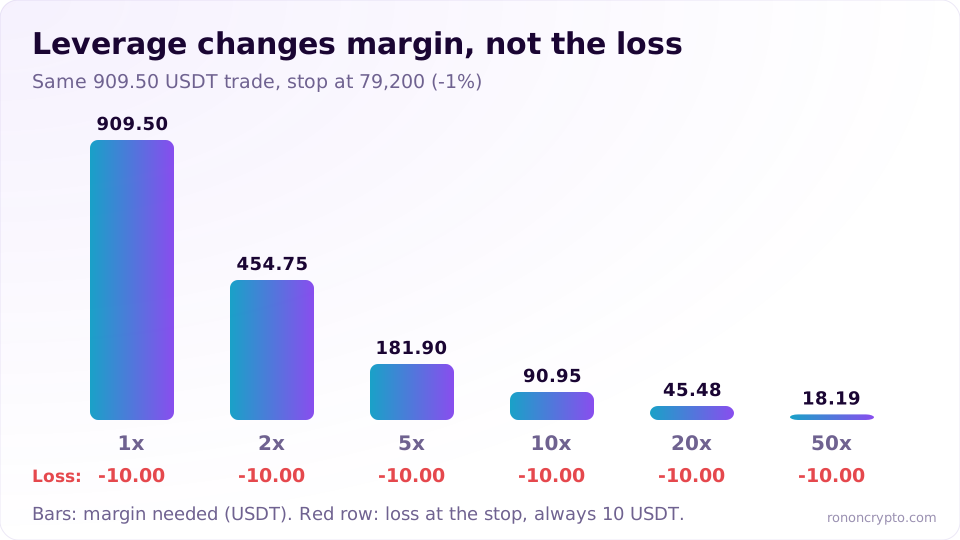
The table keeps one trade fixed: a 1,000 USDT account, 1% risk (10 USDT), BTC long at 80,000, stop at 79,200, 0.05% fee per side, position size 909.50 USDT. Liquidation prices are estimates for isolated margin with a 0.5% maintenance margin, using entry × (1 − 1/leverage + 0.5%):
| Leverage | Margin required | % of account locked | Estimated liquidation price | Distance to liquidation | Loss if stop is hit |
|---|---|---|---|---|---|
| 1x | 909.50 USDT | 90.95% | 400 | 99.50% | 10 USDT |
| 2x | 454.75 USDT | 45.48% | 40,400 | 49.50% | 10 USDT |
| 5x | 181.90 USDT | 18.19% | 64,400 | 19.50% | 10 USDT |
| 10x | 90.95 USDT | 9.10% | 72,400 | 9.50% | 10 USDT |
| 20x | 45.48 USDT | 4.55% | 76,400 | 4.50% | 10 USDT |
| 50x | 18.19 USDT | 1.82% | 78,800 | 1.50% | 10 USDT |
| 100x | 9.10 USDT | 0.91% | 79,600 | 0.50% | Liquidated before the stop |
The last column stays at 10 USDT from 1x to 50x. The two columns that move are margin (shrinking) and distance to liquidation (narrowing). At 100x, the 79,600 liquidation price sits above the 79,200 stop, so a 0.5% move against you closes the position while your reason for the trade is still intact. How the liquidation price is formed is covered in what is liquidation price in crypto.
When does leverage actually increase risk?
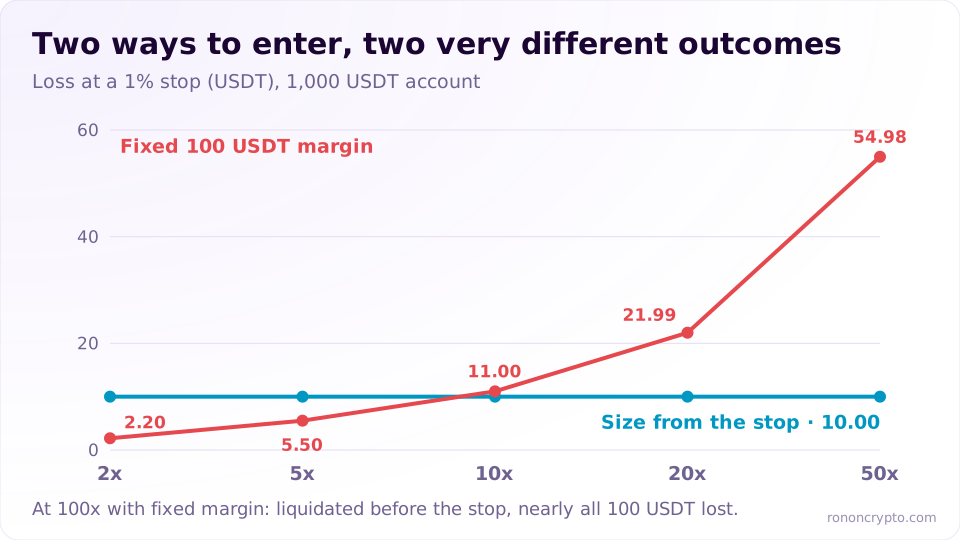
Leverage increases risk when you pick the margin first and multiply it by leverage to get the position size, because then raising leverage is the same as raising size. This is how many beginners enter: “put in 100 USDT, choose 20x”. Same BTC long at 80,000, stop at 79,200, 0.05% fee per side, fixed 100 USDT margin on a 1,000 USDT account:
| Leverage | Position size | Loss if stop is hit | % of account lost |
|---|---|---|---|
| 2x | 200 USDT | 2.20 USDT | 0.22% |
| 5x | 500 USDT | 5.50 USDT | 0.55% |
| 10x | 1,000 USDT | 11.00 USDT | 1.10% |
| 20x | 2,000 USDT | 21.99 USDT | 2.20% |
| 50x | 5,000 USDT | 54.98 USDT | 5.50% |
| 100x | 10,000 USDT | Liquidated at 79,600, about 100 USDT of margin lost | about 10% |
Same entry and same stop, yet the loss goes from 2.20 USDT to 54.98 USDT just by changing leverage. Put the full 1,000 USDT up as margin at 10x and the position is 10,000 USDT; a 1% stop then costs 109.95 USDT, almost 11% of the account on one trade.
A common first-year pattern: entering out of fear of missing out and holding losers out of an unwillingness to admit being wrong. When greedy, a trader wants a bigger position, and the fastest way to “go bigger” is to push leverage up while margin stays the same. The 1% rule reverses the order: size from the stop first, choose leverage after. The full story is on the about page.
What is effective leverage, and how is it different from the leverage setting?
Effective leverage is the total value of your open positions divided by your account balance, while the leverage setting is the number you pick on the order screen to calculate margin. The two are often very different. The example trade is set to 10x, but a 909.50 USDT position on a 1,000 USDT account has an effective leverage of only 0.91x.
Effective leverage is what reflects the account’s real exposure:
- One 909.50 USDT trade: effective leverage 0.91x, whether the setting is 10x or 50x.
- 100 USDT margin at 20x: a 2,000 USDT position, effective leverage 2x.
- 1,000 USDT margin at 10x: a 10,000 USDT position, effective leverage 10x.
With several positions open, add up all their values and divide by the account balance. Trading fees and funding rates are also charged on position value, so they grow with effective leverage, not with the leverage setting. Work out fees on position value with the trading fee calculator; base-tier fees on major platforms are listed on the futures exchange fees page.
What leverage should you use in crypto?
Use leverage low enough that the liquidation price sits a safe distance beyond your stop loss, and high enough that margin does not lock up too much of your account; no single number is right for every trade. With isolated margin, the distance to liquidation is roughly 1/leverage − maintenance margin. For liquidation to sit beyond the stop: Leverage < 1 ÷ (Stop distance % + Maintenance margin %).
The table is for a BTC long at 80,000, a 0.5% maintenance margin and 1% risk on a 1,000 USDT account:
| Stop distance | Stop price | Position size at 1% risk | Leverage where liquidation meets the stop |
|---|---|---|---|
| 0.5% | 79,600 | 1,667.36 USDT | 100x |
| 1% | 79,200 | 909.50 USDT | 66.67x |
| 1.5% | 78,800 | 625.29 USDT | 50x |
| 2% | 78,400 | 476.42 USDT | 40x |
| 3% | 77,600 | 322.74 USDT | 28.57x |
| 5% | 76,000 | 196.17 USDT | 18.18x |
The last column is a boundary, not a level to use. At the boundary, liquidation and stop coincide, and a little slippage gets you liquidated. Each platform sets maintenance margin by position tier, and cross margin works differently from isolated margin, so stay well below the boundary and confirm with the liquidation price calculator and on the platform you use.
One more condition: the wider the stop, the lower the leverage must be. A 5% stop at 20x has an estimated liquidation price of 76,400, before the 76,000 stop.
Higher leverage makes ROE look better. Does it mean more profit?
ROE rises with leverage because it divides P&L by margin, while the P&L in USDT stays the same when position size is unchanged. The full calculation is in the PnL and ROE guide. Same 909.50 USDT trade (about 0.0114 BTC), long from 80,000, closed at 81,600, 0.05% fee per side: the net profit is 17.27 USDT at every leverage level.
| Leverage | Margin | Net profit at 81,600 | ROE at take profit | ROE at the 79,200 stop |
|---|---|---|---|---|
| 5x | 181.90 USDT | 17.27 USDT | +9.50% | −5.50% |
| 10x | 90.95 USDT | 17.27 USDT | +18.99% | −11.00% |
| 20x | 45.48 USDT | 17.27 USDT | +37.98% | −21.99% |
A +37.98% ROE looks better than +9.50%, but the 1,000 USDT account receives the same 17.27 USDT, or 1.73% of the balance. Watching ROE and raising leverage is a trap for your feelings, not your money. How to read P&L and ROE is explained in PnL and ROE in crypto, and you can enter your own numbers in the PnL and ROE calculator.
Use the position size calculator before you choose leverage
The position size calculator at 1% risk follows the same order as this guide: enter account size, risk %, entry, stop loss, leverage and fees, and it returns position size, margin, the share of your account locked, the estimated liquidation price and a warning if liquidation sits before your stop. Change leverage from 10 to 50 and you will see the position size stay put while only margin and liquidation price move. How to place the stop from price structure is in the stop loss guide.
This content is for educational purposes only and is not investment advice. Trading derivatives carries the risk of losing your entire margin.
FAQ
Does higher leverage increase trading fees and funding?
No, as long as the position size stays the same. Trading fees and funding are charged on the position value, not on the margin. A 909.50 USDT position pays about 0.45 USDT in entry fees at 0.05%, whether you set 5x or 50x.
Should you change leverage while a trade is open?
Changing leverage on an open position only changes margin and liquidation price, not what you lose at the stop, because the position size stays the same. Raising leverage frees margin and pulls liquidation closer to your stop; lowering it needs more margin. Not every platform lets you change it while a position is open.
How much do you lose when you get liquidated?
With isolated margin, liquidation means losing the entire margin of that position. Put 100 USDT of margin at 100x and a move of about 0.5% against you takes almost all of it, 10% of a 1,000 USDT account, before the stop loss is even reached.
Does cross margin change the math in this guide?
The loss at the stop loss does not change, because it depends only on position size and stop distance. What changes is the liquidation price: cross margin uses your account balance as a buffer, so liquidation sits further away, but the whole account now backs the position. Each platform calculates this differently, so confirm on the one you use.
Derivatives trading can lose you your entire margin. See the disclaimer.