 RonOnCrypto
Stop Loss in Crypto: How to Set It With the 1% Risk Rule
On this page · 8
- What is a stop loss and how does the order work?
- Why is a stop loss part of the trading plan?
- What is the 1 percent rule in trading?
- How do you calculate position size from a stop loss?
- Where should you set a stop loss?
- How does your stop loss set the risk reward ratio?
- What are the most common stop loss mistakes?
- Use the 1% position size calculator
Need leverage, liquidation price and take-profit targets? Open the full calculator.
A stop loss is a pending order that closes your position automatically when price reaches a level you chose in advance, so the loss on that trade never exceeds the amount you already accepted. In crypto, and especially on BTC and ETH perpetual futures, the stop loss is also the input for position sizing: once you know the stop price and your risk (for example 1% of the account), you can work out the position size before you enter.
This guide follows the order in which it is applied: how a stop loss order works, why the stop is part of the trading plan, the 1% rule through a losing-streak table, how to size a trade from the stop (the 909.50 USDT example), where to place the stop, how the stop sets the risk reward ratio, and three common mistakes. The short version: place the stop from price structure, then let position size carry the risk, never the other way round.
What is a stop loss and how does the order work?
A stop loss order waits at a trigger price, and when the market reaches that price it becomes an order that closes the position. There are two common types:
- Stop market: at the trigger price it becomes a market order. The order is almost certain to fill, but the fill price can be worse than the trigger when the market moves fast or liquidity is thin, according to Wikipedia, Order (exchange) (accessed 25 October 2026).
- Stop limit: at the trigger price it places a limit order. The fill is never worse than the limit, but the order may not fill at all if price jumps straight past it, also according to Wikipedia.
When the goal is to cut a loss, a stop market prioritizes getting out, while a stop limit prioritizes price. Slippage is a cost to budget for, not a reason to trade without a stop loss.
A stop can trigger on the last price or the mark price, and a wick only touches the first; see mark price vs index price.
How limit, market, stop market and stop limit orders differ, including a worked example of price gapping through a stop, is covered in futures order types.
Why is a stop loss part of the trading plan?
A stop loss is part of the plan because it answers “how much is lost if this trade is wrong” before you click, while your head is still clear. A common scenario: in the first year of trading BTC and ETH perpetual futures, a trader loses more than they win, and the reason is not a missing indicator. It is the trader: entering out of fear of missing out, revenge trading after a loss, and holding losers out of an unwillingness to admit being wrong.
The turning point comes when the question changes from “how much can this trade make” to “how much is lost if this trade is wrong”. From then on, no trade may cost more than 1% of the account. That rule forces the stop and the size to be set first, and only then the entry. The full story is on the about page.
What is the 1 percent rule in trading?
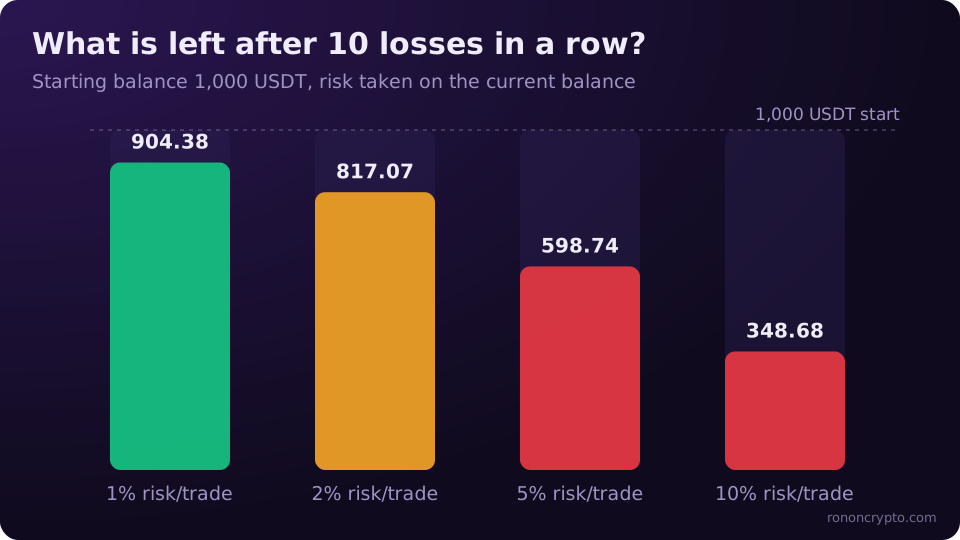
The 1 percent rule in trading limits every trade so that, if the stop loss is hit, it costs at most 1% of the total account. With a 1,000 USDT account, the maximum loss per trade is 10 USDT. The value of the rule becomes obvious during a losing streak, which happens to every trader. The table below risks a percentage of the current balance after each trade, starting from 1,000 USDT:
| Risk per trade | Left after 5 losses | Left after 10 losses | Drawdown after 10 losses | Gain needed to get back to 1,000 USDT |
|---|---|---|---|---|
| 1% | 950.99 USDT | 904.38 USDT | 9.56% | 10.57% |
| 2% | 903.92 USDT | 817.07 USDT | 18.29% | 22.39% |
| 5% | 773.78 USDT | 598.74 USDT | 40.13% | 67.02% |
| 10% | 590.49 USDT | 348.68 USDT | 65.13% | 186.80% |
The last column deserves the longest look: after 10 losses at 1% risk, the account needs a 10.57% gain to recover; after the same streak at 10% risk, it needs 186.80%.
This rule is one step of the full crypto risk management process before every trade.
How do you calculate position size from a stop loss?
Position size equals the amount you accept to lose divided by the distance to the stop loss (in %) plus the entry and exit fees:
Position size (USDT) = (Account × Risk %) ÷ (Stop distance % + Entry fee % + Exit fee %)
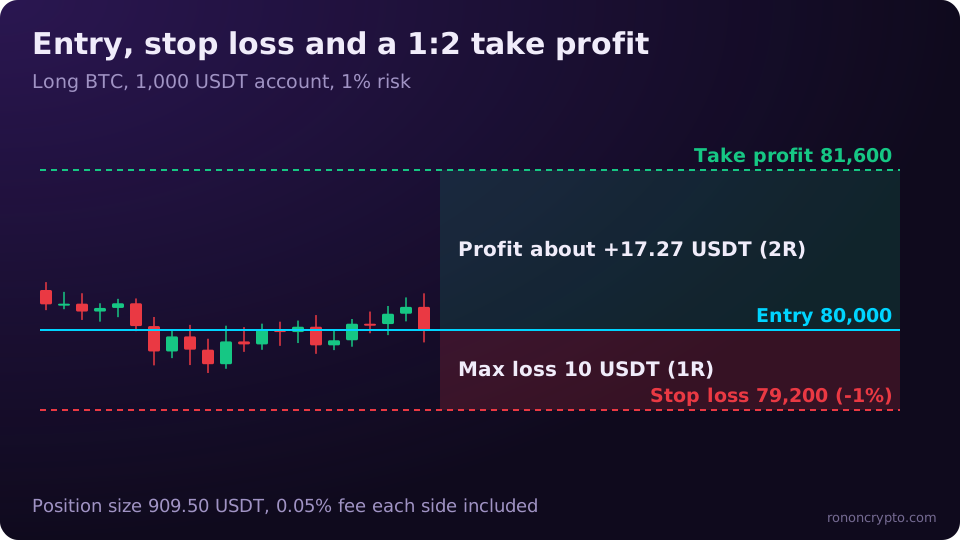
Example: a 1,000 USDT account at 1% risk means 10 USDT. You go long BTC at 80,000 USDT with a stop loss at 79,200 USDT, so the stop distance is 1%. Assume a 0.05% fee per side; the exit fee is charged at the stop price, so it is 0.05% × 79,200/80,000 = 0.0495%.
- Position size = 10 ÷ (1% + 0.05% + 0.0495%) = 10 ÷ 1.0995% ≈ 909.50 USDT, about 0.0114 BTC.
- If the stop is hit: 9.095 USDT price loss + 0.455 USDT entry fee + 0.450 USDT exit fee = exactly 10 USDT.
- Ignore fees and you would open 1,000 USDT and lose about 11 USDT, which breaks the 1% limit. With a 1% stop, fees make up about 9% of the loss.
Leverage is not in the formula. At 10x it only changes the margin required (about 90.95 USDT), not the amount you lose when the stop is hit. The same calculation works for both directions; see the guide to long vs short in crypto.
Why leverage does not change this number is explained in a separate guide.
Where should you set a stop loss?
Set the stop loss at the price where, if reached, your reason for entering is no longer valid: place it from price structure, not from the amount of money you want to risk. Three common structural reference points:
- Long: below the most recent low that price just bounced from.
- Short: above the most recent high that price was just pushed down from.
- Support or resistance zone: beyond the zone, with extra room for normal daily noise.
If the logical stop is far away, reduce the position size instead of pulling the stop closer. Example: a BTC short at 80,000 USDT with the nearest high at 81,200 USDT (1.5% away) gives a 1% risk size of about 624.71 USDT, smaller than the 909.50 USDT for a 1% stop, yet the loss if wrong is still 10 USDT.
When looking for an entry, RonOnCrypto uses only RSI for momentum and a Baseline (WMA20) for trend; the stop still goes beyond highs and lows. To see RSI and the Baseline across several timeframes at once, open the multi-timeframe RSI table; the theory is in the RSI indicator guide.
Whichever level you use, your stop must always sit before the liquidation price.
How does your stop loss set the risk reward ratio?
The risk reward ratio (R:R) compares the distance to your stop loss with the distance to your take profit, and it decides what share of trades you must win to break even. For the 909.50 USDT example with a 0.05% fee per side, the break-even win rate after fees is 55.00% at 1:1, 44.00% at 1:1.5, 36.67% at 1:2 and 27.50% at 1:3. How to calculate R:R, expectancy per trade and what happens when you move the stop are covered in the risk reward ratio guide.
What are the most common stop loss mistakes?
The three mistakes that make a stop loss useless are moving it further away when price goes against you, placing it too tight, and placing it beyond the liquidation price.
Moving the stop loss when price goes against you
Moving the stop further away breaks the position size calculation. Keep 909.50 USDT and move the stop from 79,200 to 78,400 USDT (2% away), and the loss when hit is about 19.09 USDT, almost double the planned 1%. This is exactly the “holding losers” habit described above.
Setting the stop loss too tight
A stop that is too tight gets swept by normal price noise, and fees eat a large share of the risk. A 0.2% stop (79,840 USDT) allows a size of about 3,334.44 USDT, but entry and exit fees make up about 33% of the 10 USDT loss, compared with about 9% for a 1% stop.
Placing the stop loss beyond the liquidation price
With leverage that is too high, the position is liquidated before the stop loss is reached. Estimates for isolated margin with a 0.5% maintenance margin rate, for a BTC long at 80,000 USDT:
| Leverage | Margin for 909.50 USDT | Estimated liquidation price | Compared with the 79,200 stop |
|---|---|---|---|
| 10x | 90.95 USDT | 72,400 | Liquidation far away, safe |
| 20x | 45.48 USDT | 76,400 | Safe |
| 50x | 18.19 USDT | 78,800 | Only 400 USDT beyond the stop |
| 100x | 9.10 USDT | 79,600 | Liquidated before the stop is hit |
Each platform calculates liquidation with its own position tiers, so always check with the liquidation price calculator and on the platform you use. When many high-leverage positions are liquidated at once, price can slip hard through your stop; the guide to open interest explains how cascading liquidations work.
Use the 1% position size calculator
The position size calculator at 1% risk does exactly the calculation in this guide: enter your account size, risk %, entry, stop loss, leverage and fees, and it returns the position size, margin, estimated liquidation price and a warning if liquidation sits before your stop. Use it before every trade.
This content is for educational purposes only and is not investment advice. Trading derivatives carries the risk of losing your entire margin.
FAQ
Can low leverage replace a stop loss?
No. Low leverage only pushes the liquidation price further away, while the loss still grows with every tick against you. Without a stop loss, a trade can still lose a large part of the account before it is liquidated.
Is a mental stop loss as good as a stop order on the platform?
A mental stop depends on you being present and calm at the exact moment price reaches it. A stop loss order placed on the platform triggers on its own, even while you sleep or while you are hoping the trade comes back.
What is a trailing stop?
A trailing stop is a stop loss that moves in your favor automatically, keeping a fixed distance from price. When price reverses by that distance, the position closes and keeps part of the profit already made.
Is the 1% risk based on the starting balance or the current balance?
The tables in this guide use the current balance, so after 10 losses in a row the account is at 904.38 USDT. Risking a fixed 10 USDT based on the starting balance would leave 900 USDT; using the current balance makes each loss shrink as the account shrinks.
Derivatives trading can lose you your entire margin. See the disclaimer.