 RonOnCrypto
Long vs Short in Crypto: P&L, Liquidation and Position Size for Both Sides
Need leverage, liquidation price and take-profit targets? Open the full calculator.
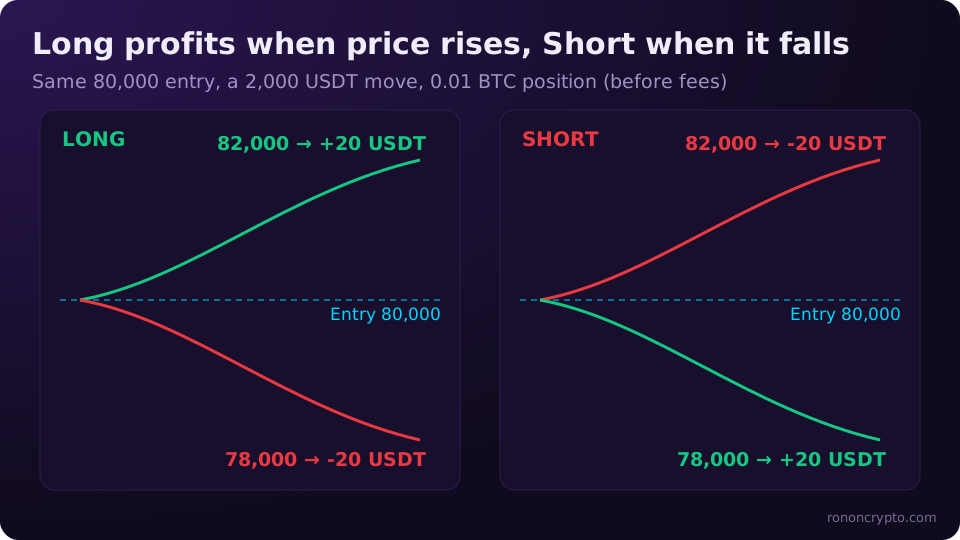
In crypto, going long means opening a position that profits when the price rises, and going short means opening a position that profits when the price falls. On BTC and ETH perpetual futures, both sides share the same margin, leverage, fee and funding mechanics, so with the same size and the same price move, long vs short P&L is almost symmetrical. The real differences sit in three places: whether the liquidation price is below entry (long) or above it (short), which side pays funding, and the exit fee, which is charged on the closing price.
This guide walks through a worked long and short P&L example, how leverage and margin work, where the liquidation price sits for each side, how fees and funding differ by direction, and finally how to size both longs and shorts at 1% risk. I have traded BTC and ETH perpetuals since 2020, and every number below matches the position size calculator I use before every trade.
What do long and short mean in crypto?
A long position gains when the price goes up and loses when it goes down; a short position gains when the price goes down and loses when it goes up. Holding a long position means owning a positive amount of an asset in the expectation that its price will rise, while a short position is set up to profit when the asset’s value falls, according to Wikipedia (Long (finance) and Short (finance), accessed 25 October 2026).
| Attribute | Long position | Short position |
|---|---|---|
| Profits when | Price rises | Price falls |
| P&L before fees | (Exit − Entry) × Quantity | (Entry − Exit) × Quantity |
| Stop loss placed | Below entry | Above entry |
| Liquidation price sits | Below entry | Above entry |
| Positive funding | Long pays | Short receives |
| On spot | Buying the coin is a long | Needs a derivative or a borrowed coin |
On a perpetual contract you do not need to own any BTC to go short. You post USDT as margin and open the position in the opposite direction, so a short is as easy to place as a long.
Long vs short P&L: a worked example
With 0.01 BTC entered at 80,000 USDT and a 2,000 USDT price move, the winning side makes about 19.2 USDT and the losing side loses about 20.8 USDT after fees. The example assumes a 0.05% fee per side, charged on the position value at entry and at exit, and 10x leverage (80 USDT of margin).
| Scenario | Side | P&L before fees | Entry + exit fees | Net P&L | ROE on margin |
|---|---|---|---|---|---|
| Price rises to 82,000 | Long | +20.00 | 0.81 | +19.19 USDT | +23.99% |
| Price rises to 82,000 | Short | −20.00 | 0.81 | −20.81 USDT | −26.01% |
| Price falls to 78,000 | Long | −20.00 | 0.79 | −20.79 USDT | −25.99% |
| Price falls to 78,000 | Short | +20.00 | 0.79 | +19.21 USDT | +24.01% |
Two lessons come out of this table. First, fees are deducted whichever way the trade goes, so the net win is always smaller than the net loss for the same price move. Second, the ROE looks big (almost 24%) only because it is divided by 80 USDT of margin; measured against a 1,000 USDT account, the same trade is about 1.9%. You can check every row with the PnL and ROE calculator.
How do leverage and margin work for long and short positions?
Leverage only decides how much margin you post for a given position size; it does not change your P&L in dollars when the size stays the same. Initial margin equals the position value divided by leverage, and the rule is identical for longs and shorts.
For a 0.01 BTC position at 80,000 USDT (an 800 USDT position):
- At 5x leverage: 160 USDT of margin.
- At 10x leverage: 80 USDT of margin.
- At 20x leverage: 40 USDT of margin.
At all three levels, a 2,000 USDT rise still gives the long a net profit of 19.19 USDT. What changes is the ROE on screen and the distance to the liquidation price. Beginners often look at ROE and raise leverage, when the thing that actually raises risk is a bigger position size.
Where is the liquidation price for a long vs a short?
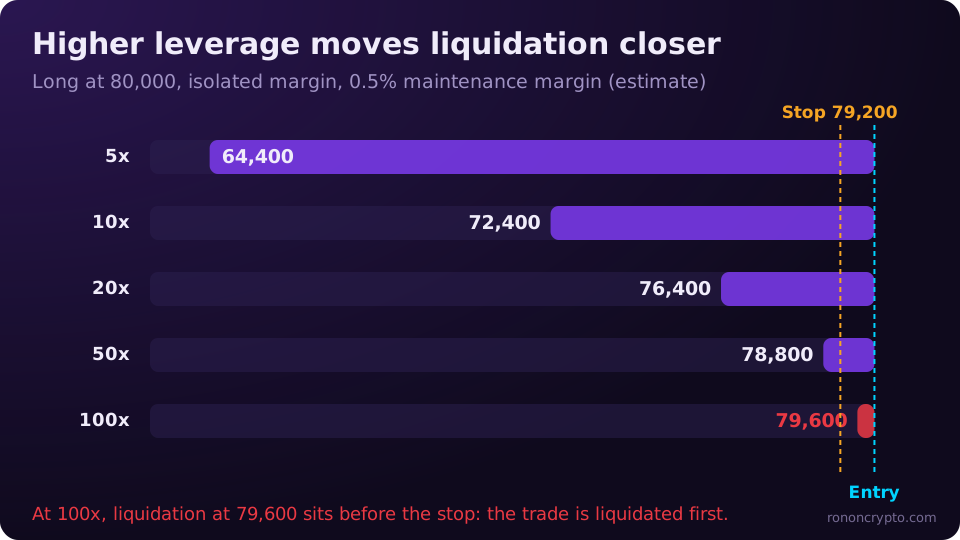
The liquidation price of a long sits below entry, the liquidation price of a short sits above entry, and the higher the leverage, the closer it moves to your entry. The tools on RonOnCrypto estimate it for isolated margin with a 0.5% maintenance margin rate:
- Long: Liquidation price ≈ Entry × (1 − 1/Leverage + 0.5%)
- Short: Liquidation price ≈ Entry × (1 + 1/Leverage − 0.5%)
The table below uses an 80,000 USDT entry and a stop loss 1% away (the long stops at 79,200, the short at 80,800):
| Leverage | Long liquidation | Short liquidation | Distance from entry | Hits the 1% stop first? |
|---|---|---|---|---|
| 5x | 64,400 | 95,600 | 19.5% | Yes |
| 10x | 72,400 | 87,600 | 9.5% | Yes |
| 20x | 76,400 | 83,600 | 4.5% | Yes |
| 50x | 78,800 | 81,200 | 1.5% | Yes, but only 0.5% away |
| 100x | 79,600 | 80,400 | 0.5% | No, liquidated first |
At 100x, the long is liquidated at 79,600 before price ever reaches the 79,200 stop. You then lose the whole margin of that trade instead of the amount you planned to lose. Every platform uses its own margin tiers and formula, so treat these as estimates and check them with the liquidation price calculator and on the platform you use.
Do trading fees and funding differ between long and short?
Trading fees are charged the same way on longs and shorts, but funding has a direction: when funding is positive, longs pay shorts, and when it is negative, shorts pay longs. Funding is usually settled every 8 hours on the value of the open position.
Example with a 909.50 USDT position and an assumed funding rate of 0.01% per interval:
- Each 8-hour interval: 909.50 × 0.01% ≈ 0.091 USDT.
- Each day (3 intervals): ≈ 0.27 USDT, paid by the long when funding is positive and received by the short.
The amount is small, but funding moves with the market and there are periods when it runs many times higher than this example. If you hold a position for several days, funding becomes a real cost that belongs in your plan. Current funding rates are on the data dashboard, and the mechanism is explained in my guide to crypto funding rates. You can estimate entry and exit fees (maker and taker) in advance with the trading fee calculator; maker and taker fees from each platform’s official fee page are compared on the futures exchange fees page.
Is going short just betting against the market?
No. A short is simply choosing the falling-price side, and it needs exactly the same discipline as a long: a stop loss and a position size worked out in advance. In theory a price can rise without limit, so a short seller’s loss has no ceiling unless something stops it (Short (finance), accessed 25 October 2026). On an isolated-margin perpetual, liquidation caps the loss at that trade’s margin, but losing the whole margin is still the worst case, not a plan.
Three misconceptions I see often:
- “The market is falling, so a short always works”: sharp drops are often followed by fast rebounds, and a short near the bottom with a tight stop is easily stopped out.
- “Shorting against the trend catches the top”: this is usually an entry driven by fear of missing out, exactly the kind of mistake I made in my first year, when I lost more than I won. These days I use a Baseline (WMA20) to filter the trend before choosing a side, and I check it in the multi-timeframe RSI table.
- “Shorts are riskier than longs, so the stop should be wider”: stop distance follows price structure, not the direction of the trade.
How do you size a long or short position at 1% risk?
Position size equals the amount you accept to lose divided by the stop distance plus the entry and exit fees, and the formula is the same for longs and shorts. This is the formula my calculator uses:
Position size (USDT) = (Account × Risk %) ÷ (Stop distance % + Entry fee % + Exit fee %)
The exit fee is charged at the stop price, so it equals Fee % × (Stop price ÷ Entry price). Example: a 1,000 USDT account, 1% risk (10 USDT), BTC entered at 80,000, a stop 1% away, a 0.05% fee per side and 10x leverage:
| Side | Stop price | Position size | BTC quantity | Margin at 10x | Loss if stopped out |
|---|---|---|---|---|---|
| Long | 79,200 | 909.50 USDT | ≈ 0.0114 | 90.95 USDT | 10.00 USDT |
| Short | 80,800 | 908.68 USDT | ≈ 0.0114 | 90.87 USDT | 10.00 USDT |
The two sides are almost identical. The short is about 0.8 USDT smaller because its stop sits above entry, so the exit fee is charged on a slightly higher price. What matters is that both lose exactly 10 USDT, fees included, if the trade is wrong.
This rule was my turning point: I stopped asking “how much can this trade make” and started asking “how much do I lose if I am wrong”. Since then no trade, long or short, may cost more than 1% of the account, and the stop has to be set before I work out the size. How to place the stop from price structure is covered in my guide to stop losses in crypto.
Use the tool
Before you click long or short, open the position size calculator, pick the side, and enter your account size, entry, stop, leverage and fees. It returns the position size, margin, estimated liquidation price and a warning if liquidation sits before your stop. To see P&L at a specific exit price, use the PnL and ROE calculator.
This content is for educational purposes only and is not investment advice. Trading derivatives carries the risk of losing your entire margin.
FAQ
Can you short crypto on the spot market?
Buying spot is only ever a long: you own the coin and profit when the price rises. To short, you need a derivative such as a futures or perpetual contract, or you borrow the coin and sell it on margin.
Why would anyone open a long and a short on the same coin at the same time?
Two equal positions almost cancel each other's price P&L, which is usually called a hedge. You still pay entry and exit fees on both legs, so holding both without a plan for closing one side only costs you fees.
What is the long/short ratio?
It is the ratio of accounts or volume holding longs versus shorts on a given platform, and each platform defines and measures it differently. A single ratio does not tell you where the price will go; it only tells you which side is crowded.
Should I open a long or short with a limit order or a market order?
A market order fills immediately and usually pays the higher taker fee; a limit order waits for your price and usually pays the lower maker fee, but it may not fill. That fee gap adds up quickly if you trade many times a month.
Derivatives trading can lose you your entire margin. See the disclaimer.