 RonOnCrypto
What Is Liquidation Price in Crypto and How Do You Calculate It?
On this page · 7
- What does it mean to get liquidated in crypto?
- How do you calculate liquidation price with isolated margin?
- How does leverage change the liquidation price?
- How do isolated and cross margin affect the liquidation price?
- Liquidation price vs stop loss: which must come first?
- Why is the liquidation price on the exchange different from a calculator?
- Use the liquidation price calculator
Need leverage, liquidation price and take-profit targets? Open the full calculator.
Liquidation price is the price at which the trading platform force-closes your leveraged position, because the margin left in it has fallen to the minimum maintenance margin. Being liquidated means the position is closed for you at that level; with isolated margin, you lose the entire margin you put into that trade. Example: a BTC long at 80,000 USDT with 10x leverage and a 0.5% maintenance margin rate has an estimated liquidation price of 72,400 USDT, 9.5% below entry.
This guide covers, in order: what being liquidated means, the liquidation price formula for isolated margin, a leverage table from 2x to 100x, how margin mode affects liquidation, liquidation price vs stop loss, and why the platform number differs from a calculator. The short version: leverage does not decide how much you lose when you are wrong, position size and the stop loss do; leverage only decides your margin and how close liquidation sits.
What does it mean to get liquidated in crypto?
Getting liquidated means the platform closes your position automatically because losses have eaten your margin down to the maintenance margin, the minimum collateral needed to keep a position open. The idea comes from traditional markets: the maintenance requirement “is the minimum amount of collateral required to keep the position open”, according to Wikipedia, Margin (finance) (accessed 25 October 2026).
The difference is speed. In a stock margin account, the broker usually issues a margin call first; on crypto perpetual futures, the liquidation engine acts as soon as price reaches the level. Three things happen when you are liquidated:
- The position is closed: you no longer get to wait for price to come back.
- The trade’s margin is gone: with isolated margin, the loss equals exactly the margin assigned to that trade.
- Any shortfall from slippage is handled at platform level: crypto exchanges cover it with an insurance fund, and when the fund is not enough, auto-deleveraging makes high-leverage traders who are in profit give up part of their gains, according to Wikipedia, Perpetual futures (accessed 25 October 2026).
If you are new to perpetual contracts and trade direction, start with the guide to long vs short in crypto. To see where large wallets’ real liquidation prices sit right now, open the Hyperliquid liquidation map.
How do you calculate liquidation price with isolated margin?
With isolated margin on USDT-margined contracts, the estimated liquidation price equals the entry price times (1 − 1/leverage + maintenance margin rate) for a long, and times (1 + 1/leverage − maintenance margin rate) for a short:
Long: Liquidation price = Entry × (1 − 1/Leverage + Maintenance margin rate) Short: Liquidation price = Entry × (1 + 1/Leverage − Maintenance margin rate)
Example with BTC at 80,000 USDT, 10x leverage and a 0.5% maintenance margin rate:
- Long: 80,000 × (1 − 0.1 + 0.005) = 72,400 USDT, liquidated after a 9.5% drop.
- Short: 80,000 × (1 + 0.1 − 0.005) = 87,600 USDT, liquidated after a 9.5% rise.
Simplified, the distance from entry to liquidation is 1/leverage − maintenance margin rate. At 10x that is 10% − 0.5% = 9.5%. The 1/leverage part is your initial margin as a share of position value; the maintenance margin is the last buffer the platform keeps, so liquidation arrives slightly before your margin would reach zero. This is the same formula used in the site’s liquidation price calculator.
How does leverage change the liquidation price?
Higher leverage moves the liquidation price closer to entry: doubling leverage roughly halves the distance to liquidation. The table uses the isolated margin formula above, a BTC entry at 80,000 USDT and a 0.5% maintenance margin rate:
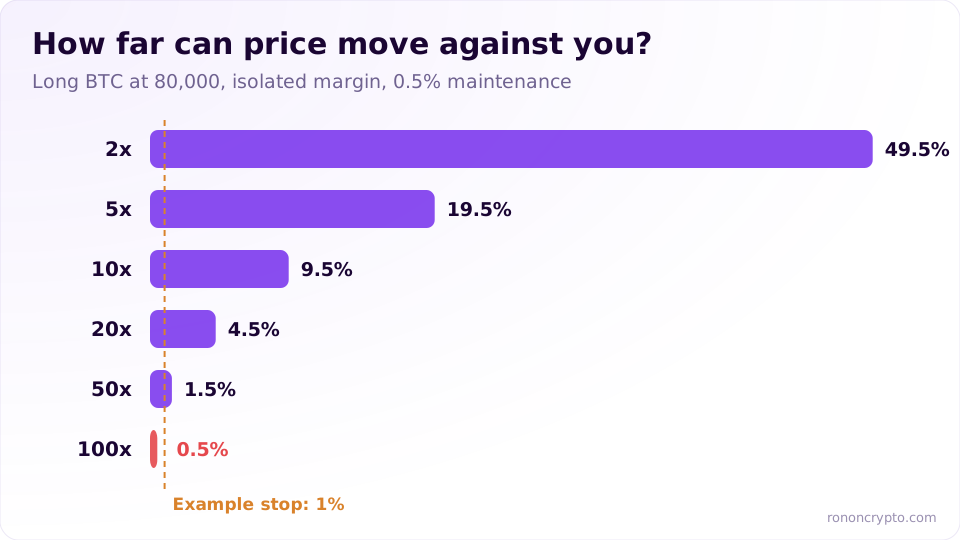
| Leverage | Long liquidation price | Short liquidation price | Distance to liquidation |
|---|---|---|---|
| 2x | 40,400 | 119,600 | 49.5% |
| 3x | 53,733.33 | 106,266.67 | 32.83% |
| 5x | 64,400 | 95,600 | 19.5% |
| 10x | 72,400 | 87,600 | 9.5% |
| 20x | 76,400 | 83,600 | 4.5% |
| 25x | 77,200 | 82,800 | 3.5% |
| 50x | 78,800 | 81,200 | 1.5% |
| 100x | 79,600 | 80,400 | 0.5% |
Going from 10x to 20x cuts the distance to liquidation from 9.5% to 4.5%; at 100x it is only 0.5%, or 400 USDT on BTC at 80,000. That 0.5% is tighter than the 1% stop used in the stop loss guide. Why leverage does not change risk when the position is sized correctly is covered in the guide to crypto leverage.
How do isolated and cross margin affect the liquidation price?
Isolated margin uses only the margin you assign to one position, while cross margin uses the shared balance of the account as margin for every open position. So cross margin usually puts liquidation further away, but one bad trade can take the account with it, and other positions’ profit and loss move this trade’s liquidation price. The calculator on this site only estimates isolated margin. Worked numbers and when to use each mode are in the isolated vs cross margin guide.
Liquidation price vs stop loss: which must come first?
Your stop loss must always sit before the liquidation price, because the stop is a loss you chose while liquidation is a loss equal to your entire margin. Under the rule that no trade may cost more than 1% of the account, size the position from the stop first and only then choose leverage (the story behind the rule is on the about page).
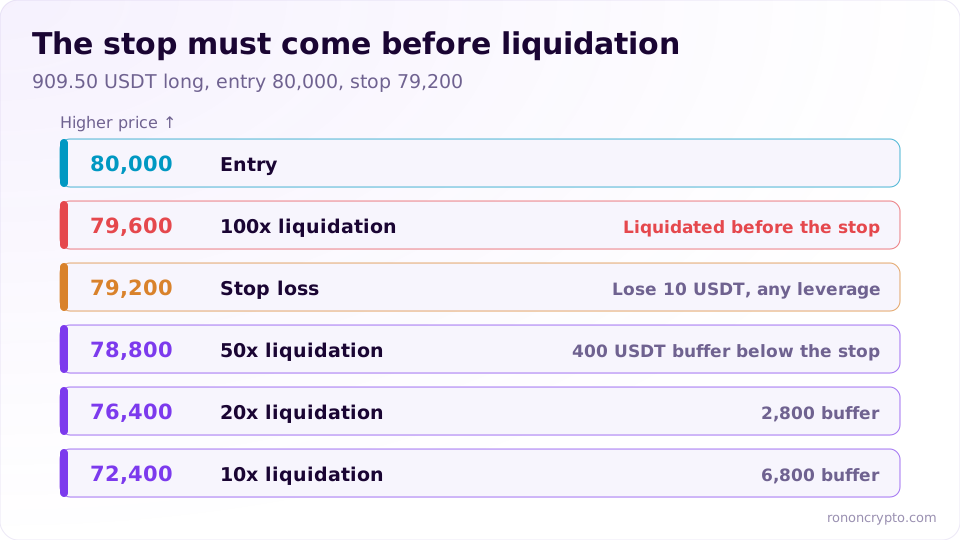
Reuse the example from the stop loss guide: a 1,000 USDT account, 1% risk, a BTC long at 80,000, a stop at 79,200 (1% away), and a 0.05% fee per side. The position size is 909.50 USDT. If the stop is hit, the loss is exactly 10 USDT including fees, whatever leverage you use. Leverage changes only two things:
| Leverage | Margin required | Estimated liquidation price | Buffer from the 79,200 stop to liquidation |
|---|---|---|---|
| 5x | 181.90 USDT | 64,400 | 14,800 USDT |
| 10x | 90.95 USDT | 72,400 | 6,800 USDT |
| 20x | 45.48 USDT | 76,400 | 2,800 USDT |
| 50x | 18.19 USDT | 78,800 | 400 USDT |
| 100x | 9.10 USDT | 79,600 | Liquidated before the stop |
Position size, on the other hand, is what changes risk. Put the full 1,000 USDT up as margin at 10x and the position is 10,000 USDT: hitting the 79,200 stop costs about 109.95 USDT (almost 11% of the account), and with no stop, liquidation at 72,400 takes all 1,000 USDT.
The same formula gives the threshold leverage, where liquidation lands exactly on the stop: 1 ÷ (stop distance % + maintenance margin rate %), so a 1% stop has a threshold of about 66.67x. The full table by stop distance is in the crypto leverage guide, under “What leverage should you use in crypto?”.
The position size calculator runs this check for you and warns when liquidation sits before the stop.
To see where the liquidation prices of many large positions sit around the current price, see how to read a liquidation heatmap.
Why is the liquidation price on the exchange different from a calculator?
The liquidation price on a platform usually differs slightly from the formula, because platforms use maintenance margin tiers by position size, charge a liquidation fee, and trigger on the mark price rather than the last traded price. Four common sources of difference:
- Maintenance margin tiers: larger positions carry a higher maintenance margin rate. At 10x, raising it from 0.5% to 1% moves the long liquidation price from 72,400 to 72,800; at 50x, from 78,800 to 79,200, exactly the stop in the example.
- Mark price: liquidation usually triggers on the mark price, not on a single wick on one exchange.
- Liquidation and trading fees: they make the real buffer thinner than the formula. Fee levels differ by platform; see the exchange fee overview.
- Funding rate: funding paid or received can change your margin depending on how the platform books it; see the funding rate guide.
When many high-leverage positions are liquidated at once, price can slip straight through your stop; the guide to open interest explains cascading liquidations. Track funding and open interest daily on the market data dashboard.
Where the mark price comes from and how it differs from the last price is covered in mark price vs index price.
Use the liquidation price calculator
The liquidation price calculator does exactly the calculation in this guide: pick long or short, enter the entry price, leverage and maintenance margin, and it returns the estimated liquidation price and the distance to it in %, for isolated margin on USDT-margined contracts. Before a trade, size the position with the position size calculator, then check that liquidation sits well beyond the stop. Always confirm the final number on the platform you use.
This content is for educational purposes only and is not investment advice. Trading derivatives carries the risk of losing your entire margin.
FAQ
Can a 1x position be liquidated?
It can, especially a short. Under the isolated margin formula with a 0.5% maintenance margin rate, a 1x long from 80,000 USDT is only liquidated near 400 USDT, but a 1x short is liquidated near 159,600 USDT, a 99.5% rise.
Does the liquidation price move when the trade is in profit?
With isolated margin, usually not. The liquidation price comes from the entry, the leverage and the margin of the trade, so unrealized profit does not push it further away. It only changes when you add or remove margin, or when the maintenance margin tier changes with position size.
Is adding margin a good way to avoid liquidation?
Adding margin pushes liquidation further away, but it also raises the amount you can lose. A 909.50 USDT position at 20x has 45.48 USDT of margin and liquidates at 76,400; add another 45.48 USDT and liquidation moves to 72,400, yet the money at stake has doubled. If the stop loss is in the right place, extra margin does not make the loss when you are wrong any smaller.
What is a liquidation cascade?
A liquidation cascade happens when the forced orders from one group of liquidated positions push price into the liquidation level of the next group. It runs longer when open interest is high, and price can slip hard through your stop loss.
Derivatives trading can lose you your entire margin. See the disclaimer.