 RonOnCrypto
Isolated vs Cross Margin: How Each Changes Liquidation and What You Can Lose
On this page · 7
- What are isolated margin and cross margin?
- How is the cross margin liquidation price calculated?
- Isolated vs cross margin on the same trade: how big is the difference?
- Why does cross margin spread risk across the whole account?
- Does margin mode still matter if you size trades with the 1% rule?
- When should you use isolated margin and when cross margin?
- Calculate the liquidation price before choosing a margin mode
Need leverage, liquidation price and take-profit targets? Open the full calculator.
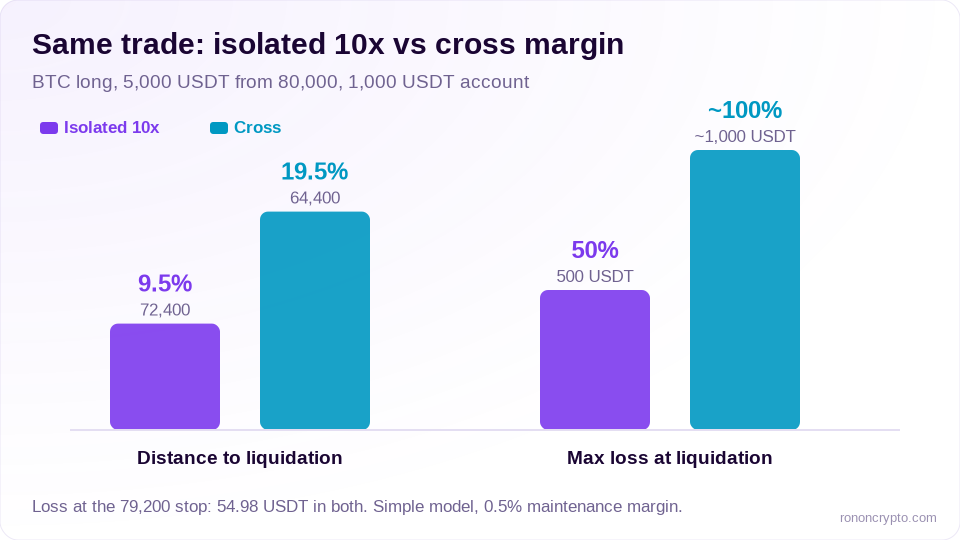
Isolated margin caps what you lose at liquidation to exactly the margin you assign to one trade, while cross margin uses the whole available balance of your futures account as a buffer, so liquidation sits further away but can take almost the entire account. Example: a 1,000 USDT account opens a 5,000 USDT BTC long at 80,000. With isolated margin at 10x, liquidation is at 72,400 and the most you lose is 500 USDT; with cross margin, liquidation is near 64,400 and you lose close to 1,000 USDT.
The liquidation price guide introduces both modes. This guide goes deeper, in order: short definitions, a formula to estimate cross margin liquidation, a side-by-side comparison on the same trade, why risk spreads across the whole account, whether margin mode still matters when size follows the 1% rule, and when to use each mode. The short version: the margin mode does not change the loss when your stop is hit; it only decides how much you lose when the stop fails to fill.
What are isolated margin and cross margin?
Isolated margin is the mode where each trade has its own margin and only that margin absorbs losses; cross margin is the mode where the available balance of the futures account is shared as margin for every open position. Both rely on the same threshold, the maintenance margin, which “is the minimum amount of collateral required to keep the position open”, according to Wikipedia, Margin (finance) (accessed 25 October 2026).
The difference comes down to which money stands behind the trade:
- Isolated: only that trade’s margin, for example 500 USDT for a 5,000 USDT position at 10x.
- Cross: the whole available balance, for example all 1,000 USDT, plus the unrealized profit or loss of other positions.
The isolated margin liquidation formula and the 2x–100x leverage table are already in the liquidation price guide, so this guide does not repeat them.
How is the cross margin liquidation price calculated?
For a single position in cross margin, the estimated liquidation price is entry × (1 − Balance ÷ Position size + Maintenance margin rate) for a long, and entry × (1 + Balance ÷ Position size − Maintenance margin rate) for a short. This is a simple model built to illustrate the idea, with these assumptions:
- USDT-margined contracts, with only a BTC position in the account.
- Liquidation happens when equity (balance plus unrealized P&L) falls to a 0.5% maintenance margin on position value, measured at entry like the site’s calculator.
- Fees, funding, margin tiers and mark price differences are ignored.
Compared with the isolated formula, only one term changes: 1/leverage is replaced by Balance ÷ Position size. In other words, cross margin behaves like isolated margin with the entire balance as margin. The ratio Position size ÷ Balance is the account’s effective leverage: 5,000 ÷ 1,000 = 5x, so a 5,000 USDT long in cross margin liquidates at 80,000 × (1 − 0.2 + 0.005) = 64,400 USDT, exactly the isolated liquidation price at 5x.
The consequence: in this model, the leverage you set on screen does not decide the cross margin liquidation price. Position size and balance do.
Isolated vs cross margin on the same trade: how big is the difference?
On the same 5,000 USDT BTC long at 80,000 in a 1,000 USDT account, cross margin widens the distance to liquidation from 9.5% to 19.5%, but raises the loss at liquidation from about 500 USDT to close to 1,000 USDT. The table uses the model above, a 0.5% maintenance margin, a stop at 79,200 (1% away) and a 0.05% fee per side:
| Criterion | Isolated 10x (500 margin) | Cross (1,000 balance) |
|---|---|---|
| Money behind the trade | 500 USDT | 1,000 USDT |
| Long liquidation price | 72,400 | 64,400 |
| Distance to liquidation | 9.5% | 19.5% |
| Liquidation price if short | 87,600 | 95,600 |
| Loss at the 79,200 stop | 54.98 USDT | 54.98 USDT |
| Loss at the liquidation price | 475 USDT | 975 USDT |
| Maximum loss when liquidated | 500 USDT (50% of account) | Close to 1,000 USDT (nearly 100%) |
Two rows deserve a closer look. The stop loss row is identical in both modes, because that loss depends only on position size and stop distance. The maximum loss row doubles: the 25 USDT of maintenance margin left at liquidation usually does not come back to you either, so isolated costs the full 500 USDT margin while cross costs nearly all 1,000 USDT.
The 5,000 USDT position is deliberately large to make the gap visible. Under the 1% rule, the size for this trade is only 909.50 USDT; a later section covers exactly that case.
Why does cross margin spread risk across the whole account?
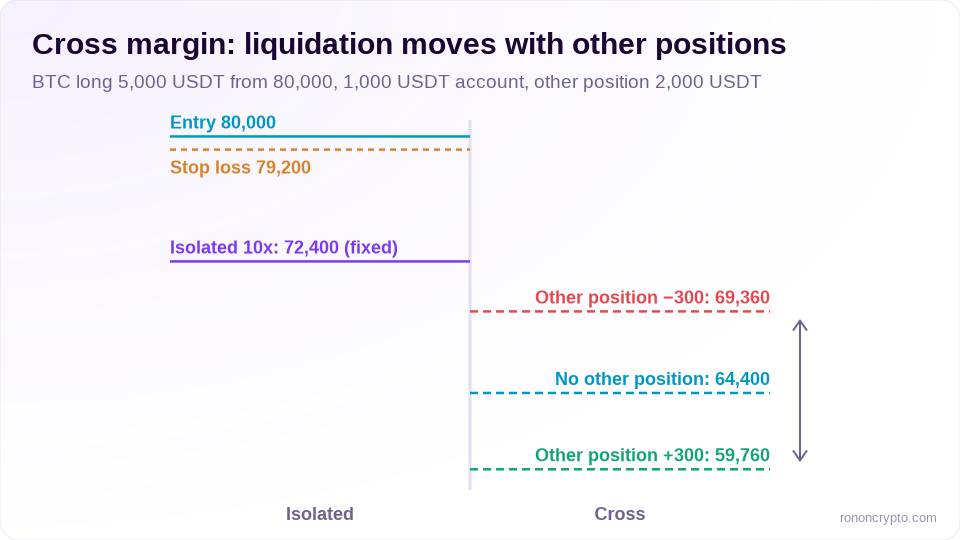
In cross margin, one position’s liquidation price moves with the profit and loss of every other position, so a losing trade in one place can drag a trade elsewhere into liquidation. Example in the same model: the 1,000 USDT account still holds the 5,000 USDT BTC long at 80,000, plus a second position of 2,000 USDT with an unrealized loss of 300 USDT.
| State of the second position | BTC long liquidation (cross) | Distance to liquidation |
|---|---|---|
| None | 64,400 | 19.5% |
| Down 300 USDT | 69,360 | 13.3% |
| Up 300 USDT | 59,760 | 25.3% |
A 300 USDT loss on the second position pulls the BTC liquidation price from 64,400 up to 69,360, even though nothing changed on the BTC trade. With isolated margin, the 10x BTC liquidation stays at 72,400 whether other positions win or lose. That is the core trade-off: cross margin lets positions support each other, but it also makes them fall together. When an account is liquidated this way, the platform usually closes positions to bring it back above maintenance margin, and you typically do not get to choose which one goes first.
Cross margin does have a real benefit: positions that offset each other, such as a long and an opposing short, need less margin. In traditional markets too, “margin requirements are reduced for positions that offset each other”, according to Wikipedia, Margin (finance) (accessed 25 October 2026).
How averaging down in cross margin drags the liquidation price toward the current price, with a three-step example, is shown in the guide on how to avoid liquidation.
Does margin mode still matter if you size trades with the 1% rule?
Yes, but only for the bad scenario: when the stop fills, both modes lose the same; when the stop fails, isolated margin is a second ceiling on the loss and cross margin removes that ceiling. Under the rule that no trade may cost more than 1% of the account, the stop and the size are always set before the click (the story is on the about page). Reuse the numbers from the stop loss guide: a 1,000 USDT account, 1% risk, a BTC long at 80,000, a stop at 79,200, a 0.05% fee per side, and a position size of 909.50 USDT.
| Scenario | Isolated 10x (90.95 margin) | Cross (1,000 balance) |
|---|---|---|
| Price hits the 79,200 stop | Lose 10 USDT | Lose 10 USDT |
| Long liquidation price | 72,400 | None (the formula goes negative) |
| Stop fails, price falls to 72,400 | Liquidated, lose 90.95 USDT | Still open, down 86.40 USDT |
| Stop fails, price falls to 60,000 | Already capped at 90.95 USDT | Still open, down 227.38 USDT |
A 909.50 USDT position is smaller than the 1,000 USDT balance, an effective leverage of about 0.91x, so in this model the cross margin long has no liquidation price: if BTC went to 0 the loss would be 909.50 USDT and the account would still not reach the liquidation threshold. That sounds safer, but it actually means the ceiling is gone. Stops fail for three common reasons: forgetting to place one, moving it further away, or price slipping through it in a fast crash.
So once size follows the stop, the real question is not “which mode loses less” but “if the stop fails, what is the most loss to accept”. The full risk framework is in the crypto risk management guide.
When should you use isolated margin and when cross margin?
Isolated margin fits when you want every trade to have its own loss ceiling and a liquidation price you can calculate in advance; cross margin fits when you hold positions that offset each other and you manage the risk of the whole account. A summary by situation, not trading advice:
| Situation | Better-suited mode | Why |
|---|---|---|
| One independent trade with a clear stop | Isolated | A second loss ceiling; liquidation price can be calculated with the tool |
| Several same-direction, highly correlated trades (BTC and ETH both long) | Isolated | In cross, one shared drop drags the trades into liquidation together |
| Offsetting positions (long one pair, short a correlated pair) | Cross | Gains on one side absorb losses on the other, so less margin is needed |
| Avoiding early liquidation from short-term volatility on a small position | Cross, with a mandatory stop | Liquidation sits further away, but only the stop limits the loss |
| Learning futures | Isolated | The maximum loss on each trade is visible in advance |
Whichever mode you pick, the loss at the stop is still set by position size. How the reward compares with that risk is covered in the risk reward ratio guide, and logging each trade in a trading journal, with an extra margin mode column if you switch between modes, shows you which trades were ever liquidated and why.
Calculate the liquidation price before choosing a margin mode
The site’s liquidation price calculator only estimates isolated margin; with cross margin, read the number on your platform, because it depends on the balance and the other positions at each moment. How to use the site’s two calculators before a trade:
- Size the position with the position size calculator from the balance, 1% risk and the stop.
- With isolated margin, check in the liquidation price calculator that liquidation sits well beyond the stop.
- With cross margin, estimate quickly with the formula in this guide: enter a leverage equal to Position size ÷ Balance in the liquidation calculator to see the rough liquidation zone for a single position (for example 5,000 ÷ 1,000 = 5x gives 64,400), then confirm the real number on the platform. A ratio below 1x, such as 909.50 ÷ 1,000, means the long has practically no liquidation price in this model.
The crypto leverage guide explains why leverage only changes margin and liquidation, not risk, when the position is sized correctly.
This content is for educational purposes only and is not investment advice. Trading derivatives carries the risk of losing your entire margin.
FAQ
Can cross margin lose more than the futures account balance?
Usually not. Liquidation triggers when account equity falls to the maintenance margin, so the loss stops around that balance. Any shortfall when price slips past the liquidation level is covered by the platform's insurance fund or auto-deleveraging. Whether funds in other wallets count toward cross margin depends on how the platform pools wallets, so check its wallet description.
What does the leverage setting do in cross margin?
In this guide's simple model, the cross margin liquidation price depends only on position size and balance, not on the leverage you pick. Leverage still sets the initial margin locked and the maximum size you can open. The more useful number is effective leverage: position size divided by balance, for example 5,000 ÷ 1,000 = 5x.
Does a winning trade in cross margin protect other positions?
Yes, while the profit lasts. Unrealized profit adds to equity, so other positions' liquidation prices move further away. In this guide's example, another position up 300 USDT pushes the 5,000 USDT BTC long's liquidation from 64,400 down to 59,760. When that profit disappears, the liquidation price moves back.
Can a trade switch from cross to isolated margin midway?
It depends on the platform. Many only allow a mode change when that pair has no open position or pending order, so choose the mode before you enter and confirm it on the order screen.
Derivatives trading can lose you your entire margin. See the disclaimer.