 RonOnCrypto
How to Avoid Liquidation in Crypto Futures: Why Accounts Get Wiped Out
On this page · 9
- What does liquidation mean in crypto?
- How far can price move before you get liquidated at each leverage?
- Why do traders get liquidated? 6 common causes
- How much difference does a stop loss make?
- How does cross margin wipe out the whole account?
- How does averaging down move the liquidation price closer?
- How do funding and wicks push a position into liquidation?
- Checklist: how to avoid liquidation in crypto futures
- Use the liquidation price calculator before you enter
Need leverage, liquidation price and take-profit targets? Open the full calculator.
You get liquidated in crypto futures when price moves far enough against your position that your margin falls to the maintenance margin, and the platform force-closes it. Most or all of that margin is lost. To avoid liquidation, size each trade from a stop loss and keep that stop well before the liquidation price.
The liquidation price guide covers the mechanics and the formula. This guide covers something else: why traders actually get liquidated, what each cause costs in numbers, and a checklist to run before you place the order. The short version: liquidations rarely come from one unexpected move; they usually come from oversized positions with no stop that fires before the liquidation price.
The examples use the standard trade from the other guides on this site: a 1,000 USDT account, 1% risk (10 USDT), BTC long at 80,000, stop at 79,200, 0.05% fee per side, a position of 909.50 USDT (0.01136875 BTC), 10x leverage, 90.95 USDT margin, isolated margin, 0.5% maintenance margin and an estimated liquidation price of 72,400. Price paths and scenarios are simulated to show the mechanics; they are not market data or trade recommendations.
What does liquidation mean in crypto?
Liquidation is the forced closing of a leveraged position by the platform once the remaining margin reaches the maintenance margin, the minimum collateral needed to keep a position open. The maintenance margin concept follows Wikipedia, Margin (finance) (accessed 25 October 2026); on crypto perpetual futures the liquidation engine acts automatically, with no margin call first.
Traders use “getting liquidated” or “blowing up the account” for two situations with very different costs:
| Situation | Margin mode | What you lose at liquidation | Example on a 1,000 USDT account |
|---|---|---|---|
| One trade liquidated | Isolated | That trade’s margin (plus fees) | Standard trade at 10x: about 91.40 USDT, 9.14% of the account |
| Whole account wiped | Cross, or isolated with the whole balance in one trade | Almost the entire futures balance | A 10,000 USDT position: about 1,000 USDT |
Both come from the same arithmetic. How much you lose depends on the money behind the position; how soon you get liquidated depends on position size relative to that money.
How far can price move before you get liquidated at each leverage?
With isolated margin and a 0.5% maintenance margin rate, price only needs to move about 1/leverage minus 0.5% against you: 9.5% at 10x, 4.5% at 20x and 0.5% at 100x. The table uses a BTC long at 80,000, with two extra columns showing how the same leverage carries very different risk depending on how much margin you commit:
| Leverage | Long liquidation price | Adverse move | Margin for the 909.50 USDT trade | Position if all 1,000 USDT is margin |
|---|---|---|---|---|
| 5x | 64,400 | −19.5% (15,600 USDT) | 181.90 USDT | 5,000 USDT |
| 10x | 72,400 | −9.5% (7,600 USDT) | 90.95 USDT | 10,000 USDT |
| 20x | 76,400 | −4.5% (3,600 USDT) | 45.48 USDT | 20,000 USDT |
| 50x | 78,800 | −1.5% (1,200 USDT) | 18.19 USDT | 50,000 USDT |
| 100x | 79,600 | −0.5% (400 USDT) | 9.10 USDT | 100,000 USDT |
The middle column matches the table in the liquidation price guide. The last two columns are where the danger shows: 18.19 USDT at 50x and 1,000 USDT at 50x share the same 78,800 liquidation price, yet one costs 1.8% of the account and the other costs all of it. Why position size, not leverage, decides the loss is explained in the crypto leverage guide.
Why do traders get liquidated? 6 common causes
Most liquidations trace back to six habits: oversized positions, leverage that puts liquidation before the stop, no stop or a moved stop, cross margin stacking same-direction trades, averaging down a loser, and letting funding or wicks hit thin margin. Each one below is priced on a 1,000 USDT account:
| # | Cause | Mechanism | Example number |
|---|---|---|---|
| 1 | Oversized position | The whole balance used as margin | 10,000 USDT position: the stop costs 109.95 USDT (11%); no stop means liquidation at 72,400 and the full 1,000 USDT |
| 2 | Leverage too high for the stop distance | Liquidation arrives before the stop | 100x: liquidation at 79,600 sits ahead of the 79,200 stop |
| 3 | No stop, or a stop moved away | Liquidation replaces the stop | Standard trade: 91.40 USDT lost instead of 10 USDT |
| 4 | Cross margin with same-direction trades | Positions share one balance | BTC long 5,000 + ETH long 5,000: a joint 9.5% drop wipes the account |
| 5 | Averaging down a loser | Size grows, balance does not | Liquidation moves from 64,400 to 70,543.59, then 71,181.52 |
| 6 | Funding, fees and wicks | Thin margin gets eroded or tagged | 0.05% funding for 30 days moves 10x liquidation from 72,400 to 76,000 |
Cause 1 sits under all the others. A trade that loses 10 USDT has to hit its stop 100 times in a row to lose 1,000 USDT; a 10,000 USDT trade with no stop needs one 9.5% drop. Per-trade risk and limits on total open risk are covered in the crypto risk management guide.
Cause 2 is the small-size trap: the size is a correct 909.50 USDT, but picking 100x to lock less margin puts liquidation at 79,600, ahead of the 79,200 stop, so the trade is liquidated for its 9.10 USDT margin plus fees before the stop can fire. The threshold for a 1% stop is about 66.67x. Causes 3 to 6 are worked through below.
How much difference does a stop loss make?
On the same 909.50 USDT trade at 10x isolated, hitting the 79,200 stop costs 10 USDT, while skipping the stop and getting liquidated at 72,400 costs about 91.40 USDT, more than 9 times as much. The 91.40 USDT is 90.95 USDT of margin plus 0.45 USDT entry fee; any liquidation fee the platform charges is not included.
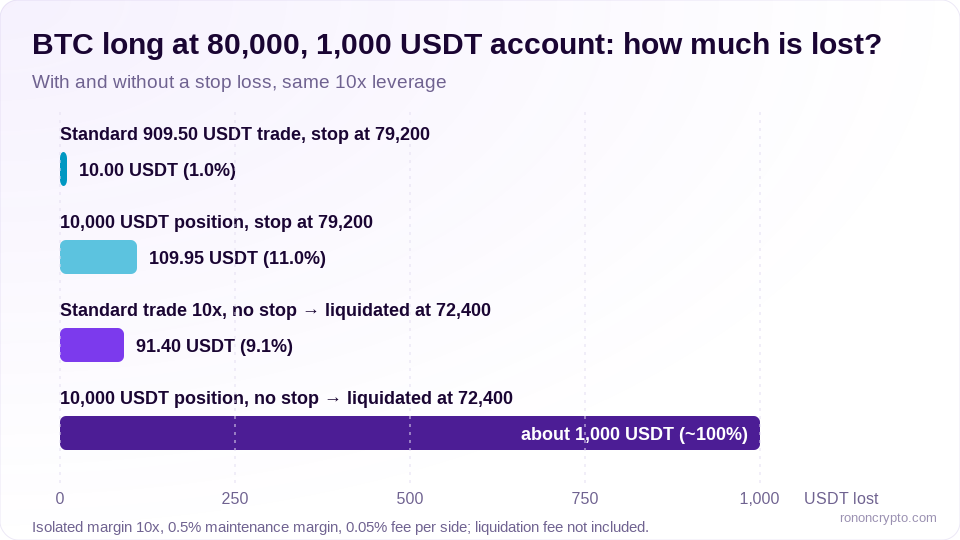
| Scenario (1,000 USDT account, BTC long at 80,000) | Exit | Loss | % of account |
|---|---|---|---|
| Standard trade, isolated 10x, with stop | 79,200 | 10.00 USDT | 1.00% |
| Standard trade, isolated 10x, no stop | Liquidated at 72,400 | 91.40 USDT | 9.14% |
| Standard trade, cross margin, no stop | Still open at 72,400 | 86.40 USDT unrealized | 8.64% |
| Standard trade, cross margin, no stop | Still open at 60,000 | 227.38 USDT unrealized | 22.74% |
| 10,000 USDT position (whole balance at 10x), with stop | 79,200 | 109.95 USDT | 11.00% |
| 10,000 USDT position, no stop | Liquidated at 72,400 | About 1,000 USDT | About 100% |
The two cross margin rows show why “not liquidated” is not the same as safe. The 909.50 USDT position is smaller than the 1,000 USDT balance, so in the simple model of the isolated vs cross margin guide it has no liquidation price; in exchange, the loss has no ceiling and keeps growing with price. Isolated margin is a second ceiling; the stop loss is the main one.
The last row is the classic wiped account: same direction, same entry, same 10x as the standard trade, but 11 times the size, so about 11 times the loss when wrong, and about 100 times without a stop.
How does cross margin wipe out the whole account?
In cross margin every position draws on one balance, so adding same-direction trades shrinks the distance to liquidation for the whole account according to total size, not per trade. The simple model from the cross margin guide: the account is liquidated when equity falls to 0.5% of total position value, ignoring fees and funding.
| Positions in a 1,000 USDT cross account | Total size | Joint drop that wipes the account | Matching BTC liquidation price |
|---|---|---|---|
| BTC long 5,000 USDT only | 5,000 USDT | −19.5% | 64,400 |
| BTC long 5,000 + ETH long 5,000, falling by the same % | 10,000 USDT | −9.5% | 72,400 |
| As above, ETH falling 1.5 times as much as BTC (illustrative assumption) | 10,000 USDT | BTC −7.6%, ETH −11.4% | 73,920 |
Adding the ETH long does not make the BTC trade look worse on paper, but because the two usually fall together in a broad sell-off, the account can now absorb only half the drop. If the second coin moves harder, the account goes when BTC is down just 7.6%. With isolated margin at 10x, each 5,000 USDT trade has its own 500 USDT ceiling; if both are liquidated you still lose 1,000 USDT, so isolated margin does not rescue oversizing, it only separates risk trade by trade.
How does averaging down move the liquidation price closer?
Averaging down (buying more as a long loses to lower the average entry) grows total size while the balance stays put, so in cross margin it drags the liquidation price toward the current price. The average entry does fall, but the buffer to liquidation shrinks much faster.
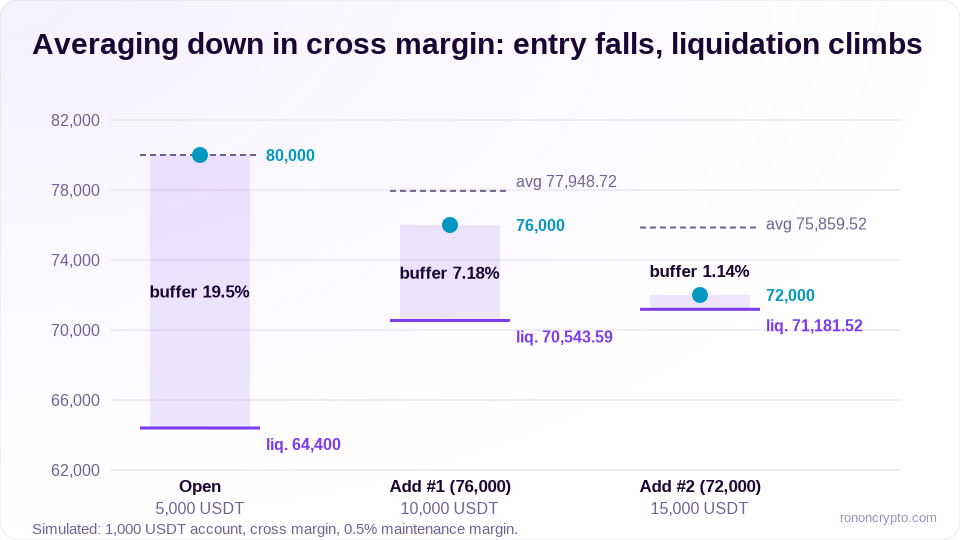
Simulated scenario, 1,000 USDT account, cross margin, 0.5% maintenance margin on position value at entry:
| Step | Current price | Size (at entry) | Average entry | Liquidation price | Distance from current price |
|---|---|---|---|---|---|
| Open BTC long | 80,000 | 5,000 USDT | 80,000 | 64,400 | 19.5% |
| Price falls, 250 USDT unrealized loss | 76,000 | 5,000 USDT | 80,000 | 64,400 | 15.26% |
| Add 5,000 USDT | 76,000 | 10,000 USDT | 77,948.72 | 70,543.59 | 7.18% |
| Add another 5,000 USDT | 72,000 | 15,000 USDT | 75,859.52 | 71,181.52 | 1.14% |
After the second add, equity is down to about 236.84 USDT and price is 1.14% from liquidation, roughly 820 USDT on BTC. Without averaging down, the same 5,000 USDT position at 72,000 is 500 USDT under water, but liquidation is still far away at 64,400. Averaging down turns a losing trade that could survive into one that a small further dip finishes off.
In isolated margin the result depends on how you add. Adding 909.50 USDT at 76,000 with a matching 90.95 USDT of margin (still 10x) moves the combined liquidation down to 70,543.59, but doubles the money in the trade to 181.90 USDT. Adding the same size with only 18.19 USDT of margin (the new part at 50x) pushes combined liquidation up to 73,661.54, 3.08% from the current price instead of 4.74% before the add. Either way, price reaching 76,000 means the 79,200 stop was ignored, and the trade no longer risks 1%.
How do funding and wicks push a position into liquidation?
Steady funding payments and short wicks do not liquidate accounts on their own, but they hit positions with thin margin: funding erodes margin and moves liquidation closer, and a wick can reach a liquidation level only 1–2% from entry. Both get worse as leverage rises.
Funding eats into margin
Funding is charged on position value, not on margin, so the same funding payment is a much bigger share of margin at high leverage. The formula and real funding data are in the funding rate guide; the site’s summary of 20 daily bulletins from 24 October to 12 November 2026 shows BTC funding on one exchange’s USDT perpetual never above 0.01% per 8 hours. The two rates below are illustrative assumptions, assuming the platform deducts funding from the isolated position margin and price stays flat (accounting differs between platforms):
| 909.50 USDT standard trade | Funding per 8 hours | Held 7 days | Held 30 days |
|---|---|---|---|
| 10x (90.95 margin) | 0.01% | Pays 1.91 USDT, liquidation 72,568 | Pays 8.19 USDT, liquidation 73,120 |
| 10x (90.95 margin) | 0.05% | Pays 9.55 USDT, liquidation 73,240 | Pays 40.93 USDT, liquidation 76,000 |
| 50x (18.19 margin) | 0.01% | Pays 1.91 USDT, liquidation 78,968 | Pays 8.19 USDT, liquidation 79,520 |
| 50x (18.19 margin) | 0.05% | Pays 9.55 USDT, liquidation 79,640 | Liquidated from about day 10 with price flat |
At 50x with 0.05% funding, margin is eaten down to the maintenance level in about 10 days and the position is closed without price falling at all. At 10x with the same funding, it takes about 63 days. Negative funding works the other way: longs get paid.
Wicks and mark price
A wick is a fast move that reverses inside the same candle; it only liquidates positions whose liquidation price is within its reach. Simulation: a trader puts 100 USDT of margin at 50x (a 5,000 USDT position) with no stop, liquidation at 78,800. A −1.6% drop to 78,720 that bounces back to 80,000 is enough to liquidate it for 100 USDT (10% of the account), even though the candle closes at the entry price. The same wick against a 10x position leaves liquidation at 72,400 still 6,320 USDT away.
Many platforms liquidate on mark price rather than last price, so a spike that appears on one order book may not reach liquidation; the drop has to be broad enough to pull mark price down too. How mark price is built, and which price triggers stop orders, is covered in mark price vs index price.
Checklist: how to avoid liquidation in crypto futures
To avoid liquidation, lock in the maximum loss before you enter: size from 1% risk, place the stop with the entry, keep liquidation well beyond the stop, and never let one trade or one group of trades share the whole balance. Seven checks before every trade:
- Risk 1% of the account per trade: 10 USDT on 1,000 USDT; size from the stop distance, not from the margin you feel like posting.
- Place the stop with the entry: a stop added later is easy to forget or move; use reduce-only so it can only close the position.
- Keep the stop well before liquidation: a rule of thumb (not a standard from any platform) is that the gap from stop to liquidation should be at least the gap from entry to stop. With a 1% stop and 0.5% maintenance margin, that caps leverage at 40x (liquidation 78,400, 800 USDT beyond the stop); liquidation lands exactly on the stop at 66.67x.
- Use isolated margin for standalone trades: each trade gets its own ceiling if the stop fails.
- Count total open risk: several same-direction trades on highly correlated coins act like one big trade, especially in cross margin.
- Do not average down a loser: once price is through the stop, close as planned instead of adding size to lower the average.
- Track funding on multi-day holds: add expected funding to the trade’s risk, and recheck the liquidation price on the platform every few days.
This checklist lowers the chance of losing more than you chose; it does not remove risk. Price can still gap through a stop in a fast crash, and the loss when a stop fills is still a real loss.
Use the liquidation price calculator before you enter
The site’s liquidation price calculator estimates the liquidation price and the distance to it in % for isolated margin on USDT-margined contracts, using the same formula as this guide. You pick long or short and enter the entry price, leverage and maintenance margin rate; the calculation runs in your browser and reads no account data.
The order of operations before a trade: size the position with the position size calculator from your balance, 1% risk and stop price; then put the leverage you plan to use into the liquidation price calculator and confirm liquidation sits far enough beyond the stop, per step 3 of the checklist. In cross margin the liquidation price depends on your balance and other positions, so the final number has to be read on your platform.
For information only, not investment advice. Leveraged derivatives trading carries the risk of losing your entire margin.
FAQ
Can you owe the exchange money after liquidation?
Usually not. Liquidation fires when margin falls to the maintenance level, so the loss stops around the position margin (isolated) or the futures balance (cross). If price slips past the liquidation level and the position closes at a worse price, the shortfall is normally covered by the platform's insurance fund; when the fund is not enough, auto-deleveraging (ADL) forces some profitable opposing positions to reduce. Terms differ between platforms, so read the liquidation section of the terms before trading.
Can you get your money back after being liquidated?
No. The position was closed at the liquidation price, the margin became a realized loss, and the position does not reopen if price comes back. Be wary of anyone offering to recover funds after a liquidation: a valid liquidation has no refund mechanism.
What leverage is safe from liquidation?
No leverage level guarantees you will never be liquidated; even a 1x short has a liquidation price. What matters is whether your stop sits before liquidation and whether size follows your risk. With a stop 1% away and a 0.5% maintenance margin rate, leverage of about 66.67x or more puts liquidation ahead of the stop.
How much do you lose when you get liquidated?
In isolated margin, you lose the full margin of that position plus fees already paid, and many platforms charge a liquidation fee on top. In cross margin, the loss can reach almost the entire futures balance. Large positions are sometimes liquidated in parts according to margin tiers, so the final number depends on your platform's rules.
Can you get liquidated on spot crypto?
Not in the sense of a forced close. Buying spot involves no borrowing and no maintenance margin, so a 50% drop leaves you holding the same coins with a 50% unrealized loss. Liquidation only applies when leverage is involved: futures, perpetual contracts or margin trading with borrowed funds.
Derivatives trading can lose you your entire margin. See the disclaimer.