 RonOnCrypto
What Is PnL in Crypto? Realized PnL, Unrealized PnL and ROE
On this page · 7
PnL (profit and loss) is the amount of money a trade makes or loses: the difference between entry and exit price times the quantity, minus fees. On BTC and ETH perpetual futures, PnL comes in two states: unrealized PnL (the profit or loss of a position that is still open) and realized PnL (the part locked in when you close). ROE divides PnL by the margin, so the same profit shows a bigger ROE the higher the leverage.
This guide goes in order: realized vs unrealized PnL, the PnL formula for longs and shorts, what ROE means in crypto, why a high ROE does not mean a big win, how fees and funding cut into PnL, and three common reading mistakes. The short version: judge a trade in USDT and as a percentage of your account, and treat ROE as a secondary number.
What is the difference between realized and unrealized PnL?
Unrealized PnL is the profit or loss of an open position at the current price, while realized PnL is the profit or loss locked in as cash when you close the trade. The difference is which number can still change:
| Unrealized PnL | Realized PnL | |
|---|---|---|
| When it exists | While the position is open | When you close all or part of the trade |
| Does it change | Moves with every tick | Fixed |
| Exit fee deducted | No, paid only when you close | Entry and exit fees deducted |
| Withdrawable | Usually not | Yes, it is in your balance |
An unrealized loss is not “no loss until the position is sold”. In a margin account, positions are revalued at the market price continuously; when the balance falls below the maintenance requirement, you must add margin or the position is closed, according to Wikipedia, Mark-to-market accounting (accessed 25 October 2026). Many crypto platforms calculate unrealized PnL from the mark price rather than the last traded price, so check how the platform you use does it.
How do you calculate PnL for a long and a short?
Net PnL on a long equals (Exit price − Entry price) × Quantity minus fees on both sides; a short flips the price difference to (Entry price − Exit price). Fees are charged on the value at entry and the value at exit:
Net PnL = Price difference in your direction × Quantity − (Entry price × Quantity + Exit price × Quantity) × Fee per side
This is exactly the formula in the site’s PnL and ROE calculator. The calculator’s default example: 0.1 BTC entered at 80,000 USDT and closed at 82,000 USDT (a 2.5% move), with a 0.05% fee per side.
| Side | P&L before fees | Entry + exit fees | Net PnL |
|---|---|---|---|
| Long | +200.00 USDT | 8.10 USDT | +191.90 USDT |
| Short | −200.00 USDT | 8.10 USDT | −208.10 USDT |
The 8.10 USDT of fees is 4.00 USDT at entry (8,000 × 0.05%) and 4.10 USDT at exit (8,200 × 0.05%). For the same price move, the winning side collects less than the losing side pays, because fees are always deducted. A two-way example with 0.01 BTC is in the guide to long vs short in crypto.
What is ROE in crypto?
ROE (return on equity) in crypto futures is net PnL divided by the position’s initial margin, expressed as a percentage. Initial margin equals entry price × quantity ÷ leverage:
ROE = Net PnL ÷ (Entry price × Quantity ÷ Leverage) × 100%
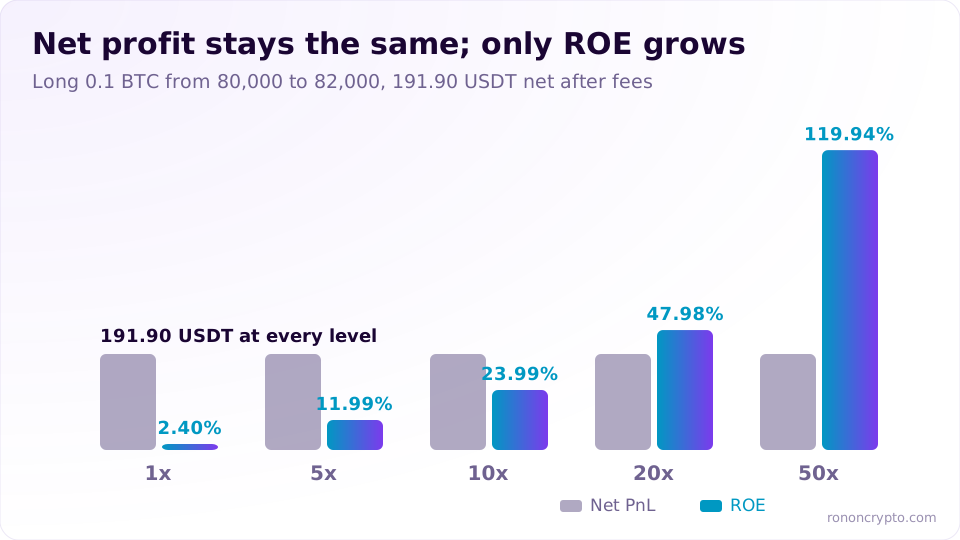
The term comes from corporate finance, where ROE measures profit relative to shareholders’ equity, according to Wikipedia, Return on equity (accessed 25 October 2026). In futures, the “equity” in the denominator is only the margin posted for that trade, not your whole account. Here is the same 0.1 BTC long from 80,000 to 82,000 USDT at different leverage levels:
| Leverage | Initial margin | Net PnL | ROE | Estimated liquidation price |
|---|---|---|---|---|
| 1x | 8,000 USDT | 191.90 USDT | 2.40% | 400 |
| 5x | 1,600 USDT | 191.90 USDT | 11.99% | 64,400 |
| 10x | 800 USDT | 191.90 USDT | 23.99% | 72,400 |
| 20x | 400 USDT | 191.90 USDT | 47.98% | 76,400 |
| 50x | 160 USDT | 191.90 USDT | 119.94% | 78,800 |
The PnL column is identical in all five rows. What leverage changes is the margin you post, the ROE on screen and the distance to liquidation (estimated for isolated margin with a 0.5% maintenance margin rate). Leverage has its own guide: crypto leverage explained.
Why does a high ROE not mean a big profit?
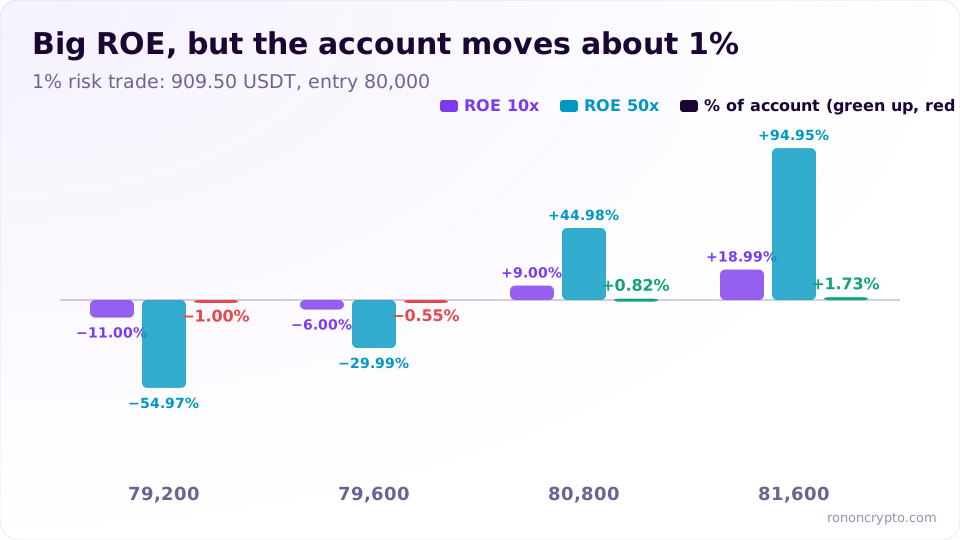
A high ROE does not mean a big profit because ROE divides by one trade’s margin, while what actually moves your account is PnL in USDT compared with your total balance. The example reuses the 1% risk trade from the stop loss guide: a 1,000 USDT account, a BTC long at 80,000, a stop at 79,200, a position of 909.50 USDT (about 0.0114 BTC) and a 0.05% fee per side.
| BTC price | Net PnL | ROE at 10x | ROE at 50x | Versus a 1,000 USDT account |
|---|---|---|---|---|
| 79,200 (stop hit) | −10.00 USDT | −11.00% | −54.97% | −1.00% |
| 79,600 (still open) | −5.45 USDT | −6.00% | −29.99% | −0.55% |
| 80,800 (still open) | +8.18 USDT | +9.00% | +44.98% | +0.82% |
| 81,600 (1:2 take profit) | +17.27 USDT | +18.99% | +94.95% | +1.73% |
The two “still open” rows show the PnL if you closed at that price, exit fee included. At 50x, a 0.5% move against you already shows an ROE of −29.99%, which scares many beginners into cutting early, even though the account is down only 0.55%. The other way round, an ROE of +94.95% sounds like nearly doubling your money, while the account is up 1.73%.
The key first-year lesson is to stop asking “how much can this trade make” and start asking “how much is lost if this trade is wrong”. That question is answered in USDT and as a share of the account, not in ROE. The full story is on the about page.
How do fees and funding affect PnL?
Trading fees come out of PnL at both entry and exit, and funding adds to or subtracts from PnL if you hold the position through a funding time. Both make real PnL differ from what you work out from the price move alone:
- Break-even after fees: with a 0.05% fee per side, a long at 80,000 USDT must close at about 80,080 USDT or higher to show positive net PnL, a move of about 0.10%. A short needs price to fall to about 79,920 USDT.
- Fees follow position value: fees are charged on the position value, not on the margin, so high leverage does not make fees cheaper. The 0.1 BTC trade pays 8.10 USDT whether the margin is 8,000 or 160 USDT.
- Funding: a 909.50 USDT position at a 0.01% funding rate every 8 hours costs about 0.09 USDT per funding time, about 0.27 USDT a day. The mechanics are in the funding rate guide; which contracts charge funding is covered in perpetual futures explained.
Fee rates differ by platform and by maker or taker order. The futures exchange fee comparison lists the official rates tracked by RonOnCrypto, and the trading fee calculator isolates the fee part of a trade. The PnL and ROE calculator deducts fees on both sides but does not include funding.
What are the most common mistakes when reading PnL and ROE?
The three most common mistakes are treating ROE as the measure of your account’s result, forgetting fees, and treating unrealized profit as money already in hand.
Using ROE as the scoreboard
ROE only compares a trade with its own margin. Seeing +95% ROE and raising leverage on the next trade does not grow the account faster; what makes wins and losses bigger is position size. If size comes from the stop and the 1% rule, 10x and 50x both lose exactly 10 USDT when the stop is hit.
Reading ROE before fees
Many platforms show PnL and ROE before fees. The 0.1 BTC long at 10x has an ROE of 25.00% before fees and 23.99% after. One percentage point on a single winner is small, but over hundreds of trades fees are a fixed cost worth tracking.
Treating unrealized profit as money you have
Unrealized profit can disappear when price reverses, and an unrealized loss still pulls your margin toward liquidation. Holding losers because “it is not a loss until it is closed” is a common first-year habit. The fix is to set the stop loss and take profit before entering and let the trade run. Where liquidation sits relative to your stop is covered in liquidation price explained.
Use the PnL and ROE calculator
The PnL and ROE calculator does exactly the calculation in this guide: pick long or short, enter entry price, exit price, quantity in coin, leverage and fee per side, and it returns net PnL after fees, ROE on margin, PnL before fees, total fees, initial margin and the price move. To decide how many coins to trade before you check PnL, start with the position size calculator.
This content is for educational purposes only and is not investment advice. Trading derivatives carries the risk of losing your entire margin.
FAQ
Are ROE and ROI the same thing on a trading platform?
In futures trading, many platforms use ROI or PnL % for the same idea: profit or loss divided by the position's margin. The label and whether fees are deducted differ from one platform to another, so read the explanation shown on the interface you use.
How is PnL calculated when part of a position is closed?
The closed part becomes realized PnL and the open part stays unrealized. For example, a 0.1 BTC long from 80,000 that closes 0.05 BTC at 81,000 USDT with a 0.05% fee per side locks in 45.98 USDT; the other half keeps moving with price.
Does spot trading have PnL and ROE?
It has PnL, with the same formula as a long but no leverage and no funding. Buying 0.01 BTC at 80,000 and selling at 82,000 USDT with a 0.05% fee per side nets 19.19 USDT, about 2.40% on the 800 USDT you put in.
Can unrealized profit be withdrawn?
Usually not. Unrealized profit only becomes a withdrawable balance after you close the trade; until then a reversal can erase it. Some platforms let you use unrealized profit as margin for other positions, so check the rules where you trade.
Derivatives trading can lose you your entire margin. See the disclaimer.