 RonOnCrypto
Perpetual futures explained: how crypto perps work and how they differ from dated futures
On this page · 8
- What are futures, and how do perpetual futures differ from dated futures?
- Why do perpetual futures track spot without an expiry date?
- A perpetual futures trade from entry to exit: a BTC example
- What does leverage change on perpetual futures, and what does it not?
- What does it cost to hold a perpetual futures position?
- What risks are specific to perpetual futures?
- What should you check before your first perpetual futures trade?
- Use the tool: check live funding and size the trade before you enter
| Pair | Price | 24h | Funding (8h) | Annualized | Open interest |
|---|---|---|---|---|---|
 BTC | - | - | - | - | - |
 ETH | - | - | - | - | - |
 SOL | - | - | - | - | - |
Source: public exchange APIs (Binance, OKX fallback). Annualized = 8h funding × 3 × 365. Open the full dashboard.
Perpetual futures (also called perpetual swaps or “perps”) are derivatives that track the price of an asset such as BTC or ETH with no expiry date, can be held for as long as you like, and are anchored to the spot price by a funding payment that longs and shorts pay each other. You do not own the coin, you only gain or lose with its price. You open the position with a fraction of its value, called margin, which is why perpetual futures allow leverage and can be liquidated.
This guide goes in order: what futures are and how perpetual futures differ from dated futures, why perps track spot without an expiry, a full BTC trade from entry to exit, what leverage changes and what it does not, the cost of holding, the risks specific to perps, and a checklist before your first trade. The short version: the risk of a perpetual futures trade sits in the stop distance and the position size, not in the leverage number.
| Attribute | Value |
|---|---|
| Type | Derivative contract, no ownership of the underlying asset |
| Expiry date | None, hold as long as you like |
| How it tracks spot | Funding rate, usually settled every 8 hours |
| Common margin | USDT (linear, USDT-M) or the coin itself (inverse, coin-M) |
| Specific risks | Liquidation, accumulated funding, auto-deleveraging (ADL) |
What are futures, and how do perpetual futures differ from dated futures?
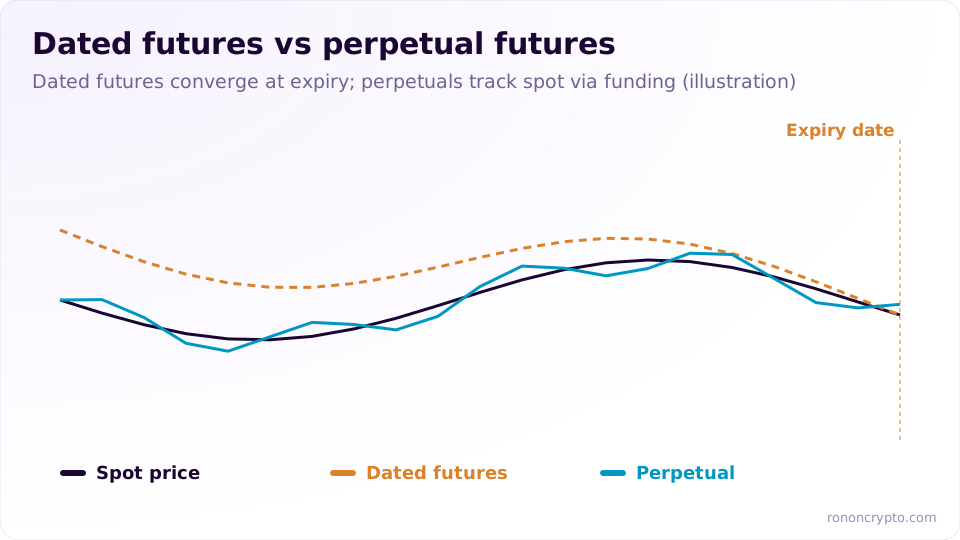
Futures are agreements to buy or sell an asset at a price fixed today for a set expiry date; perpetual futures are futures with that expiry date removed. Dated futures converge to the spot price at expiry, and anyone who wants to stay in the trade must close the old contract and open the next one (a “roll”). According to Wikipedia, Perpetual futures (accessed 25 October 2026), perpetuals have no pre-specified delivery date, so they can be held indefinitely and avoid the basis risk that repeated rolling creates.
| Spot | Dated futures | Perpetual futures | |
|---|---|---|---|
| You own the coin | Yes | No | No |
| Expiry date | Not applicable | Yes: weekly, monthly or quarterly | No |
| Leverage | No (except spot margin) | Yes | Yes |
| How it tracks spot | It is the spot price | Converges at expiry | Periodic funding |
| Can be liquidated | No | Yes | Yes |
Also according to Wikipedia, the economist Robert Shiller proposed perpetual futures in 1992; the inverse perpetual for crypto was created by Alexey Bragin in 2011, and the contract type spread widely from 2016.
Why do perpetual futures track spot without an expiry date?
Perpetual futures track spot through the funding rate: when the contract trades above spot, longs pay shorts; when it trades below, shorts pay longs, usually every 8 hours. The payment makes holding the crowded side more expensive, which pulls the contract price back toward the asset price. Wikipedia describes funding as a regular payment made to push the contract price closer to the asset price.
Remove the expiry date and something else has to force convergence; funding takes that role. How to calculate funding, negative funding, annualized funding and how to read it with open interest are covered in the guide to crypto funding rates. The live funding table for BTC, ETH, SOL, BNB and XRP is on the market data dashboard and on this page.
A perpetual futures trade from entry to exit: a BTC example
A perpetual futures trade has five numbers to know before you click: position size, margin, stop price, liquidation price and holding cost. The example is shared with the other guides on this site: a 1,000 USDT account, 1% risk (10 USDT), a long on a USDT-margined BTC perpetual at 80,000 USDT, a stop loss at 79,200 USDT, a take profit at 81,600 USDT (1:2 risk reward), 10x leverage, a 0.05% fee per side and a 0.5% maintenance margin rate.
| Item | Value |
|---|---|
| Position size at 1% risk | 909.50 USDT (0.01136875 BTC) |
| Initial margin at 10x | 90.95 USDT |
| Estimated liquidation price | 72,400 USDT (9.5% below entry) |
| Stop hit at 79,200 | Net loss 10.00 USDT after 0.90 USDT fees, ROE −11.00% |
| Target hit at 81,600 | Net profit 17.27 USDT after 0.92 USDT fees, ROE +18.99% |
| Funding if held 3 days at 0.01% per 8h | About 0.82 USDT |
The 909.50 USDT size comes from (Account × Risk %) ÷ (Stop distance % + Entry fee % + Exit fee %), explained step by step in the stop loss guide. ROE is net P&L divided by margin, so −11.00% ROE sounds scary but is only 1% of the account; reading PnL and ROE correctly is covered in PnL and ROE in crypto. A short works the same way in reverse: a short at 80,000 USDT with 10x has an estimated liquidation price of 87,600 USDT; see long vs short in crypto.
Entering and exiting with limit, market or stop orders, plus the reduce-only and post-only options, is covered in futures order types.
What does leverage change on perpetual futures, and what does it not?
Leverage on perpetual futures only changes the margin you put up, the ROE figure and the distance to the liquidation price; it does not change the USDT you lose when the stop is hit, as long as the size was set from the stop. The table keeps the same 909.50 USDT trade and changes only leverage:
| Leverage | Margin | Loss at stop | ROE at stop | Est. liquidation price | Distance from entry |
|---|---|---|---|---|---|
| 2x | 454.75 USDT | 10.00 USDT | −2.20% | 40,400 | 49.5% |
| 5x | 181.90 USDT | 10.00 USDT | −5.50% | 64,400 | 19.5% |
| 10x | 90.95 USDT | 10.00 USDT | −11.00% | 72,400 | 9.5% |
| 20x | 45.48 USDT | 10.00 USDT | −21.99% | 76,400 | 4.5% |
| 50x | 18.19 USDT | 10.00 USDT | −54.97% | 78,800 | 1.5% |
The “Loss at stop” column is the same on every row, and that is the point of the table. ROE does scale with leverage: at the take profit, ROE is +3.80% at 2x but +94.95% at 50x, while the real money is 17.27 USDT either way. What leverage truly makes worse is the liquidation price: at 50x, liquidation sits only 400 USDT below the stop; at 100x, the liquidation price of 79,600 USDT is above the stop, so the position is liquidated before the stop can fire. More in crypto leverage explained and what is liquidation price.
What does it cost to hold a perpetual futures position?
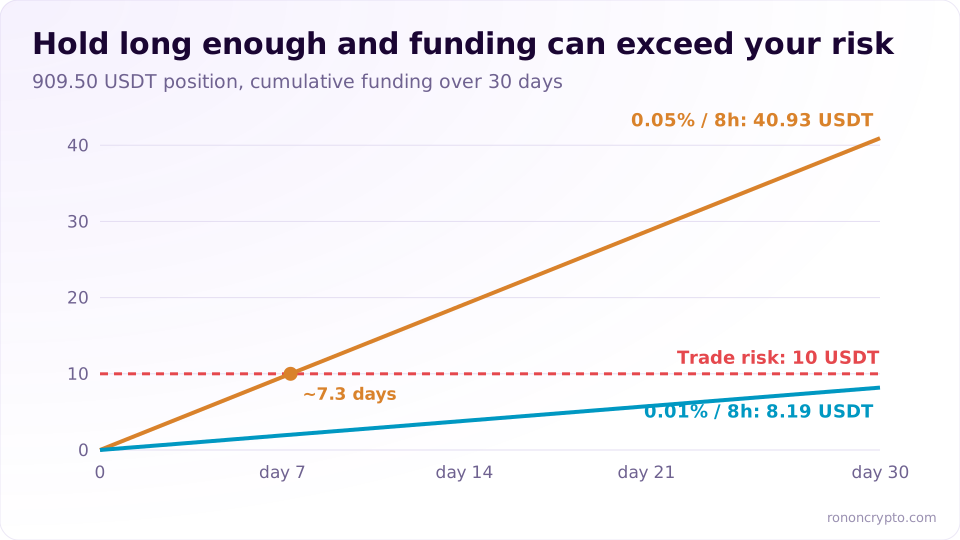
Holding a perpetual futures position costs a trading fee once per side plus funding paid (or received) every interval, and both are charged on position value, not on margin. So high leverage does not make fees cheaper: a 909.50 USDT position pays the same fees whether its margin is 18.19 or 454.75 USDT. The table converts funding into a share of the 10 USDT risk budget, assuming you pay funding at every interval:
| Holding time | Funding at 0.01% per 8h | Share of 10 USDT risk | Funding at 0.05% per 8h | Share of risk |
|---|---|---|---|---|
| 1 day | 0.27 USDT | 2.73% | 1.36 USDT | 13.64% |
| 7 days | 1.91 USDT | 19.10% | 9.55 USDT | 95.50% |
| 30 days | 8.19 USDT | 81.86% | 40.93 USDT | 409.28% |
Entry and exit fees on the example trade are only about 0.90 to 0.92 USDT, so a trade held for a few weeks can cost more in funding than the whole initial risk. Fee levels differ by platform; base-tier maker and taker fees are listed on the futures exchange fees compared page, and you can cost your own trade with the trading fee calculator.
What risks are specific to perpetual futures?
Perpetual futures carry three risks that buying spot does not: liquidation, funding that adds up over long holds, and auto-deleveraging (ADL) during violent moves.
- Liquidation: when losses eat margin down to the maintenance level, the position is force-closed and its margin is lost. According to Wikipedia, crypto perpetuals typically offer high leverage, so the distance to liquidation can be very short.
- Accumulated funding: each payment is small, but as the table shows, 7 days at 0.05% per 8h almost equals the full risk budget.
- ADL: according to Wikipedia, auto-deleveraging forces high-leverage, profitable traders to give up part of their profit during high volatility, so a winning position can be closed when you did not plan it.
A common scenario in the first year of trading BTC and ETH perpetual futures: more losses than wins, from entering out of fear of missing out and holding losers out of an unwillingness to admit being wrong. The rule that no trade may cost more than 1% of the account comes out of that, and the leverage table above shows why it holds no matter which leverage you pick. The full story is on the about page.
What should you check before your first perpetual futures trade?
Before your first perpetual futures trade, check five things in order: the stop price, the position size for your risk, the liquidation price against the stop, the current funding, and total fees.
- Stop price: set it from price structure (a low, a high, a support zone), not from the amount you want to risk.
- Position size: work it out from the stop and your risk % with the position size calculator.
- Liquidation price: it must sit beyond the stop; check it with the liquidation price calculator and on the platform you use, since each one has its own margin tiers.
- Funding: check the current rate on the dashboard if you plan to hold through several funding times.
- Expected P&L: enter entry, exit and quantity in the PnL and ROE calculator to see real USDT rather than just ROE.
Use the tool: check live funding and size the trade before you enter
The funding table on this page and on the market data dashboard shows which side is paying which right now on BTC, ETH, SOL, BNB and XRP perpetual futures. Then open the 1% position size calculator, enter your account, entry, stop, leverage and fees, and it returns the size, margin, estimated liquidation price and a warning if liquidation sits before your stop. It is the step to take before every perpetual futures trade.
This content is for educational purposes only and is not investment advice. Trading derivatives carries the risk of losing your entire margin.
FAQ
Does trading perpetual futures mean owning the coin?
No. A perpetual futures position is a contract that gains or loses with price; you do not own BTC or ETH. You cannot withdraw coins from the position, and profit and loss are settled in the margin asset, such as USDT.
What is the difference between USDT-margined and coin-margined perpetuals?
USDT-margined (linear) perpetuals use USDT as margin and pay P&L in USDT, so the math is linear and easy to check. Coin-margined (inverse) perpetuals use the coin itself as margin, so your margin's value moves with price too; Wikipedia notes that on inverse contracts, longs are liquidated faster on a price fall than shorts are on a price rise.
Is there an overnight fee on perpetual futures?
There is no separate overnight fee, but any position still open at a funding timestamp pays or receives funding. At 0.01% every 8 hours, a 909.50 USDT position costs about 0.27 USDT a day when it is on the paying side.
Is a 1x perpetual the same as buying spot?
Close on price exposure, but different in three ways: you do not own the coin, you still pay or receive funding, and you can still be liquidated if margin falls below the maintenance level. Spot has no funding and no liquidation.
Derivatives trading can lose you your entire margin. See the disclaimer.